For So It Is Written

Text: Matthew 2:1-12

Today we celebrate the feast of our Lord’s Epiphany. The twelve days of Christmas are coming to a close as the glory of the Lord’s birth is made known to Gentile wise men from the East. During the Christmas season, we celebrated the mystery of the Incarnation – that the eternal Creator of the universe should be found in form and fashion of man, the firstborn son of the Virgin Mary. In the Epiphany season, we celebrate and confess that the man Jesus Christ, is the true eternal God come to save His people. The word Epiphany means “appearance,” or “manifestation.” During this season we’ll hear of the star and visit of the wisemen, Jesus’ Baptism (where the Father and the Spirit proclaim the Gospel), Jesus’ first miracle at Cana, and other miracles of Jesus. The last Sunday of the Epiphany season is the Transfiguration, where we receive a glimpse of Jesus’ heavenly glory.

Today, however, I’d like to draw our attention to how the wise men from the East were led to Jesus. True, the miraculous appearance of a star was involved, but how is it that they were led to Bethlehem? It was through the Word, wasn’t it? First, they went to Jerusalem, expecting to find the king of Jews in their capital. When God’s Word was consulted, though, it was shown that the child was to be born in Bethlehem. The Word revealed the Christ child to the wise men, and it reveals Him to us, as well.

I.

This is sometimes a point we miss, that it was the Word that pointed them to Bethlehem and Jesus, not the star – at least, initially. We hear of our Lord’s Epiphany every year, but let’s remind ourselves of how it goes. St. Matthew began in our text, “Now after Jesus was born in Bethlehem of Judea in the days of Herod the king, behold, wise men from the east came to Jerusalem, saying, ‘Where is he who has been born king of the Jews? For we saw his star when it rose and have come to worship him.’” Sometime after Jesus was born (we usually say about two years – since Herod ended up killing all males in Bethlehem who were 2 and under) wisemen from the East came to Jerusalem when they saw a new star appear. The idea that these men were kings or that there were three specifically doesn’t come from Scripture. The Greek word μάγοι is also used in Daniel 2 for well-studied court officials who, nevertheless, were unable to interpret the king’s dreams.

These wise men came to the capital seeking the one born king of the Jews and the current king, Herod the Great, was troubled. St. Matthew writes, “[Herod] was troubled, and all Jerusalem with him;and assembling all the chief priests and scribes of the people, he inquired of them where the Christ was to be born. They told him, ‘In Bethlehem of Judea, for so it is written by the prophet.’” Informed and encouraged by the Scriptures, the wise men set out for Jerusalem. “And behold,” says St. Matthew, “the star that they had seen…went before them until it came to rest over the place where the child was.” The wise men rejoiced; and when they found Jesus with His mother, they presented Him gifts fit for a king: gold, frankincense, and myrrh. And so, the glory of the Lord’s birth was made known to the Gentiles.

II.

Most of us have probably heard this text a few times in our lives, but this is a detail that we sometimes miss: the wise men went to the wrong place. Actually, these wise guys were wrong on two accounts. First, they were wrong about the sort of king they were looking for. Second, they were wrong about how to find Him. To their credit, the wise men weren’t alone in being wrong about the sort of king Jesus would be; Herod was wrong, too. He expected Jesus to be an earthly king, and he couldn’t have that – which led him to the atrocity he committed shortly after today’s text. Page through the Gospels and you’ll see more of this. Remember how the people in Jesus’ own synagogue tried to kill Him? Or, how about at the feeding of the 5,000 – when they were about to make Jesus king because He fed them all? In the book of Acts, the Jewish leadership conspired to arrest and kill the Apostles because they proclaimed a Messiah who died and rose for the forgiveness of sins. The wise men were wrong on the first account because of the kind of king they sought.

Second, they were mistaken in how to find the true king of Israel. The Messiah wasn’t born in a throne room, silver spoon in hand. He was born in a stable and put in a feed trough for His first bed. The way they found Him was not by the star – not initially. But it was the Word that revealed His location to them. Herod consulted the chief priests and scribes, who in turn searched the Scriptures, where it was revealed, “And you, O Bethlehem, in the land of Judah, are by no means least among the rulers of Judah; for from you shall come a ruler who will shepherd my people Israel.’” Martin Luther commented that this was to show that the wise men – who were measured wise by human standards – still needed the truth revealed to them through Scripture. We’ve all learned these words from the Catechism, “I believe that I cannot by my own reason or strength believe in Jesus Christ, my Lord, or come to Him; but the Holy Spirit has called me by the Gospel.”

III.

The wise men were wrong for seeking, first, an earthly king. The gifts they brought were typical presents for any earthborn dignitary. We are guilty of the same misdeed when we expect our heavenly king to provide primarily for our earthly happiness. We know that our Lord’s will for us is good; but that good will does not always guarantee happiness now. That time will come. We have joy and peace now – for our sins are forgiven – but the Lord does not promise happiness on earth. The wise men were also mistaken by thinking they could approach the Lord with only their human wisdom. They didn’t understand that, since the Fall, human reason is corrupt. We are born incapable of knowing God, believing, loving, or trusting in Him apart from the work of the Spirit through the Word. When the reading and study of Scripture is absent from our lives, it’s as if we, too, are stuck in Jerusalem not knowing where the Messiah actually is.

Thankfully, though, the Holy Spirit has called us by the Gospel of Christ, enlightened us with His gifts, and is at work – through Scripture – to sanctify and keep us in this true faith. During the Epiphany season, we celebrate that God is made known to us in the man, Christ Jesus. And, the Scriptures are what reveal Jesus to us. The Scriptures reveal to us the plan of God, a mystery hidden since the foundation of the world, that in Jesus Christ we have redemption, the full and free forgiveness of our sins. He set aside His glory and throne to be born in our very same flesh and blood. He is our heavenly bridegroom and we are flesh of His flesh and bone of His bone. He does not remember our sins against us but suffered to remove the burden and guilt of sin from us. And, for this, we are eternally grateful.

Today we celebrate the feast of our Lord’s Epiphany, where His glory was made manifest to Gentile wise men. The same glory of the Lord is made known to us through the Scriptures. In them it is revealed that Jesus Christ is true man and true God, come to bring us life and light. In the words of our opening hymn, “For this Thy glad epiphany all glory, Jesus, be to Thee, whom with the Father we adore, and Holy Spirit evermore.” Amen.

Now I Can Depart in Peace

Text: Luke 2:22-40

RIP. You’ve seen those letters before. If you’ve ever been in a cemetery and seen them on the old gravestones, then you know where this phrase was originally used. Nowadays, we frequently see the letters RIP in obituaries and on Facebook. The three letters are an acronym for Rest in Peace, which is the English translation of the Latin, Requiescat In Pace. Traditionally, it has referred to a couple things. It could either be a prayer to God that the soul of the deceased, having died in faith, would enjoy Christ’s peace in heaven. (This was a prayer for Christians.) It could also be a prayer that God would protect the earthly remains of the Christian as they rest in the grave until the Resurrection. Both are reflected in our committal rite. The pastor prays at one point, “Bless this grave that the body of our brother may sleep here in peace until you awaken him to glory,” and at another, “May God…keep these remains to the day of the resurrection of all flesh.”

Simeon, in our text, knew that he could die and rest in peace. He was a righteous and devout man, waiting for the arrival of the Messiah to comfort and rescue His people. The Holy Spirit had told Simeon that he would not die before seeing the Christ. So, when the holy parents brought in Jesus to be presented to the Lord, Simeon took Him up in his arms. He blessed God and gave thanks for the salvation that the Lord was already providing. He knew then that he could (and would) depart in peace. In the Lord’s Word and Sacrament we, also, see Christ – and so we, too, can depart in peace.

I.

Simeon is a figure we only talk about a few times a year, though we sing his words fairly often. Simeon is the source of the Nunc Dimittis, which we sing after we have received the Lord’s Supper. Even though we hear about Simeon in the New Testament, he might also be included among the Old Testament saints. He, like John the Baptist, is sort of like a hinge between the Testaments. The Holy Spirit tells us through St. Luke that Simeon was, “righteous and devout, waiting for the consolation of Israel.” These words could be used to describe all of the Old Testament saints, as well. Church tradition has long held that Simeon was an old man, but that can’t necessarily be proven from the text itself. What can be, however, is this: “the Holy Spirit was upon [Simeon]. And it had been revealed to him by the Holy Spirit that he would not see death before he had seen the Lord’s Christ.”

It is written in the book of Exodus that every firstborn male of man and of beast is to be dedicated to the Lord. So, when 40 days had passed, Jesus’ parents brought Him to the temple to be dedicated and to offer a sacrifice for Mary’s purification from childbirth. Earlier that day, the Spirit had told Simeon to go up into the temple. When he saw the parents bringing Jesus in, St. Luke writes, “he took Him up in his arms and blessed God and said, ‘Lord, now You are letting Your servant depart in peace, according to Your word; for my eyes have seen Your salvation that You have prepared in the presence of all peoples, a light for revelation to the Gentiles, and for glory to Your people Israel.’” Simeon knew that, seeing Jesus, he had seen the Messiah of God – the bringer of salvation for all mankind – and that he could now die in peace.

II.

Simeon, by God’s grace, beheld and, also, did hold the infant Christ in his own arms. He knew that this little child, born of the Virgin Mary, was Immanuel – God with us. This child, Simeon knew, was the Lord in the flesh to save His people. And, having seen Him, Simeon knew he could depart in peace. Simeon beheld our Lord in the flesh. Though we now live in the time post-ascension, we, too, behold the same Christ. We behold Him now in different means – The Means of Grace – but in ways no less salvific. The ways that we behold Christ now are in His Word and in His Sacrament.

On the mount of His Ascension, Jesus said words which we know well, “Go therefore and make disciples of all nations, baptizing them in the name of the Father and of the Son and of the Holy Spirit, teaching them to observe all that I have commanded you. And behold, I am with you always, to the end of the age.” He also said earlier in St. Matthew’s Gospel, “Where two or three are gathered in My name, there am I among them.” Jesus also said in St. John’s Gospel, “If anyone loves Me, he will keep My word, and My Father will love him, and We will come to him and make Our home with him.” From these words it is clear that Jesus and His Word go together. When we are gathered to hear His Word, to learn, pray it, and sing it, it is no mere human document but a means by which Christ dwells among us with His truth and grace.

We behold Christ in and through His Word, but there is yet an even more tangible we in which we behold the Lord’s Christ. Our Lutheran Confessions say, “[The Gospel] does not give us counsel and aid against sin in only one way. [For] God is superabundantly generous in His grace.” Included among the ways God’s grace gets to us is the Sacrament of the Altar. In the Lord’s Supper, we receive in our hands and on our tongues the true body and blood of Christ. The same body that Simeon held and praised in the temple some 2,000 years ago, we behold every time we receive the Sacrament. The same body which Simeon beheld distributes to us the salvation accomplished for Simeon and for us on the cross.

III.

The Holy Spirit revealed to Simeon, a righteous and devout man waiting for the consolation of Israel, that he would not die until he had seen the Christ. When the parents brought Jesus into the temple, Simeon knew he could depart in peace. As with Simeon, we live in a fallen and broken creation. The same cares and the same longings Simeon had – for life, joy, and everlasting peace, we also have. But, the same Christ which Simeon beheld in the temple, we also behold in this Lord’s house. Therefore, Simeon’s words, are also our words. Having seen the Lord’s Christ, we, too, can depart in peace.

We know, as Simeon did, that in Christ we have forgiveness and eternal life. We know that in Christ, there is no separation between our God and us – our God is us. He is fully God, yet fully man. He became such so that He might die in our place on the cross and rise from the dead for us. The forgiveness which He won He gives to us daily and richly, free beyond all measure. In Him is light, life, joy, peace, and forgiveness. Simeon beheld Him in the temple, we behold Him in Word and Sacrament, and when the Lord’s appointed time for us to depart comes, these words are ours, “Lord, now You are letting Your servant depart in peace, according to Your word; for my eyes have seen Your salvation.” Amen.

Full of Grace and Truth

Text: John 1:1-14 (15-18)

In the beginning was the Word,” St. John wrote. “And the Word was with God, and the Word was God…All things were made through Him…And the Word became flesh and dwelt among us…full of grace and truth.” Today we celebrate a holiday unlike any other. The eternal Word of God, begotten of the Father before all worlds and by whom all things exist, has been born in our human flesh. He was conceived by the Holy Spirit and is now born of the Virgin Mary. For His bed, they placed Him in a manger – whose wood foreshadows the wood of the cross. Today, the Word of God – Jesus – is come in the flesh to bring us grace and truth.

I.

When St. John began his gospel with those words, “In the beginning,” he was very intentionally bringing our minds back to the beginning of the Scriptures. Genesis 1 begins with those same words, “In the beginning, God created the heavens and the earth.” St. John brings back to our attention that God, our God, created all that exists in heaven and earth, things both visible and invisible. There is nothing that exists that did not come into being through His wonderful activity. St. John brings up Genesis 1 to show that just as God the Father and God the Spirit were present at Creation, so also was the Word of God – the Son of God. And not only was the Word of God present at the creation of all things, it was by Him that all things were made. The psalmist sings in Psalm 33, “By the Word of the Lord the heavens were made.”

So, also, St. John continues. “In the beginning was the Word, and the Word was with God, and the Word was God.He was in the beginning with God. All things were made through him, and without him was not any thing made that was made. In him was life, and the life was the light of men. The light shines in the darkness, and the darkness has not overcome it.” The exalted Word of God John writes of is Jesus. Jesus is the one who was present with the Father and Spirit before the creation of the world. Jesus is the Word by whom all things were made. And, today, we confess, “The Word became flesh and dwelt among us…full of grace and truth.”

The Eternal Word of God, by whom all things were made, has now come to us in the flesh. He has been born, just as every one of us has been. He is born just like us in every way. How this has come to be is a mystery to us, a great and wonderful one. We confess in the creeds of the Church that He has not changed from God into man, but has united the human and divine natures in Himself. He is and remains fully God, yet fully man. But, why? Why has such a great and awesome thing come to pass?

II.

As Christians, we gladly confess God as the author and source of all life. We believe that He has made all things and that after He created man in His own image, He pronounced that His creation was very good. It was very good, perfect, without sin. God blessed Adam and Eve and placed them in the Garden of Eden, to work and keep it, to be fruitful and multiply. Yet, the one thing God commanded them not to do – that, they did do. Adam and Eve were created with complete free will and with the ability to obey God fully; but they used their free will to disobey. By their disobedience, all creation was plunged into the depths of sin. That includes us.

By our birth of flesh and blood, we are included in the Fall. Adam and Eve’s disobedience and the tendency to disobey God continues on in us and in all mankind. This is why all the world is wracked with death and despair, evil, sickness, murder and war. That we are part of this is proved by our own bodies. They continually grow weaker, and, eventually we die. God said death would come from disobeying Him. And, so, it comes to us, too. St. Paul phrased it in this way, “Therefore, just as sin came into the world through one man, and death through sin, and so death spread to all men because all sinned.” The only one to whom that has not spread is Jesus Christ. 

III.

He, who was conceived by the Holy Spirit and born of the Virgin Mary, was born without the corruption of original sin. And, though He did not inherit the effects of the Fall, He was still capable of sinning – but He didn’t. He resisted temptation, He kept God’s Law fully. Though He alone was not worthy of death, He did die. He died on the cross to bring us His grace and forgiveness. By His death, He won for us forgiveness of sins. He who was the author of creation became united with His creation by taking upon Himself our human flesh. He came and died, so that in Him we might truly live.

By His birth, He brought light back into the world. The hope and faith of all God’s people is now come to fruition. What the prophets spoke of and longed to see, did come to pass in that simple manger stall. God has come to us, to be us. He is united with His creation, with us, in death, so that He might also unite us to Himself in life. By faith in Him – in His life, death, and resurrection –  He gives us the right to be children of God. And so, we are. Today, we celebrate and confess that Jesus Christ, the eternal Word of God, is now come in the flesh to bring us His grace and truth.

The Witness of John the Baptist

Text: John 1:19-28

It wasn’t just a simple fact-finding mission when the Jews from Jerusalem sent priests and Levites to John. By then, he had, for a little while, been baptizing with water for repentance and forgiveness of sins and preaching about the coming of the Messiah. Many people heard John’s preaching and believed. St. Matthew recorded that, “Jerusalem and all Judea and all the region about the Jordan were going out to him, and, they were baptized by John in the river Jordan, confessing their sins.” A lot of people were listening to John, and that made the powers-that-be in Jerusalem, namely, the high priest, nervous. So, a learned delegation of priests and Levites were sent to figure out what’s up with John.

This wasn’t just a simple fact-finding mission. It was a “get on board or get out” sort of situation. The delegation from Jerusalem wanted John to one of two things: either a) claim to be the Messiah (and, thus, make them the ones who found him); or, b) fall in line – as in, stop baptizing. John was faced with both flattery and threats, which were aimed at making him deny Christ. But, by God’s grace, St. John reports, “[John] confessed, and did not deny.” As with the Baptist, we, too are called to confess our faith in Christ. Though we often fail, by Christ’s faithfulness we are forgiven.

I.

We heard a few weeks back at our first midweek service about the announcement of John the Baptist’s birth. In Malachi chapter 4, the last chapter of the Old Testament, God promised that He would send Elijah ahead of the Christ, to prepare His way by turning the hearts of fathers to their children and the disobedient to wisdom. While the priest Zechariah was ministering in the temple, Gabriel appeared to him and told him that his wife would bear a son, whose name was to be John, and who would be filled with the Holy Spirit. Their son would go before the Lord in the spirit and power of Elijah. He would, “make ready for the Lord a people prepared.” John did do this, by preaching the Law and Gospel, and by baptizing with water.

The secular historian Josephus tells us that the Baptist amassed a large following. Many people were hearing his words and being baptized in expectation of the Messiah. This large number made the chief priest nervous. So, he sent a delegation of trained men to shut John down. First, they tried by flattery. St. Luke tells us that everyone there was wondering if John was, indeed, the Messiah himself. The delegation from Jerusalem asked him, “Who are you?” John confessed, and did not deny; “I am not the Christ,” he said. That’s a shame. Had he claimed to be the Christ, the delegation would have gladly accepted him – what, with his large following, and they now becoming the ones who found the Messiah. They went on to offer John lesser titles, the position of Elijah and prophet. He simply says, “I am the voice of one crying out in the wilderness, ‘Make straight the way of the Lord,’ as the prophet Isaiah said.” 

The delegation first tried to stop John by flattering him. If he claimed to be the Messiah, they would’ve taken it. But, if he claimed to be the Messiah, that would be denying Jesus. When flattery didn’t work, the gloves came off. They asked him, “Then why are you baptizing, if you are neither the Christ, nor Elijah, nor the Prophet?” They mean, if John isn’t the Christ, or Elijah, or a prophet – then he better fall in line. Baptism and preaching belongs to the priests and Levites, not John. But, he would not be deterred. John confessed, “I baptize with water, but among you stands one you do not know, even He who comes after me, the strap of whose sandal I am not worthy to untie.” John himself later explained why God sent him to baptize in the first place. He said, “for this purpose I came baptizing with water, that he might be revealed to Israel.”

II.

It wasn’t just a fact-finding mission when that delegation was sent to John. They were under orders to get him to stop or, otherwise, bend the knee. But, to do so would be to deny Christ. By God’s grace, John did not deny, but made a good confession of his faith. There are times (dare I say, many) where we have not fared so well. The devil brings to bear against us the same tactics he used against John. He uses flattery and threats to get us to deny the faith and, often, is sucessful. By flattery, I mean, all the things in the world that feel good that we would rather do than go to church or study God’s Word. Think about it. When we miss Church or Bible study – other than because of illness or mobility issues – most often it’s because we’re doing something “fun.” Family, sports, and sleeping, are all good things, but they can be and are used to get us away from God’s Word and Sacraments. A lot of the time we don’t think about that way, do we?

If the pleasures of the world don’t work, then the devil will use threats. Maybe the way we experience this most is by peer pressure. They always say not to talk religion at family gatherings; why? Well, fights. We don’t want fights, so we don’t talk about Jesus. Guess who wins there. It’s the same in the workplace. If you go out to eat and pray with your family, do you pray as you normally would or hushed? This is to say nothing of threats and actual physical violence that are used against our brothers and sisters all around the world. The devil uses worldly pleasures and threats to get us to deny our faith by action or omission, and we have done it.

III.

St. Paul wrote to Timothy, “If we have died with [Christ], we will also live with Him; if we endure, we will also reign with Him; if we deny Him, He also will deny us; if we are faithless, He remains faithful— for He cannot deny Himself.” St. Paul reminded Timothy that, as we have been buried with Christ in Baptism, we also live with Him. And, though we live with Christ, since we are in the flesh, we remain sinners as well. By our sins, we act as if we were faithless. Thankfully, our faithlessness does not undo Christ’s faithfulness. Though we should fall to temptation and sin and fail to make the good confession, Christ remains faithful.

He was faithful throughout His whole course on earth. He remained faithful to God’s Word and Law at every point. He was tempted in every way as we are, yet remained steadfast. He was not swayed by flattery nor by threats of violence. Even before Pilate, who claimed authority to crucify or release Him, Jesus confessed His identity and mission. Jesus remained faithful even unto death and, by His death, secured for us salvation. In Baptism we have died with Christ, and now live with Him. Though we now live in Him, we remain in the flesh and are given to bouts of unfaithfulness. We often fail to live out and confess our faith beyond these walls. Nevertheless, He remains faithful – for He cannot deny Himself, or us. Today, we remember and give thanks for this. In His faithfulness, Jesus remembered His promise to save His people, even by becoming flesh for us in the manger. The Lord grant us the same grace as John the Baptist, that we also, when faced with temptation, would also be good witnesses of Him.

The Messiah We Need

Text: Matthew 11:2-11

“You can’t always get what you want. No, you can’t always get what you want. But…sometimes, you get what you need.” These were the words the great poet Mick Jagger sang on a 1969 single from The Rolling Stones. The jury’s still out on what the specific meaning of the song is – if there is one. Some say it’s about the declining culture of the 1960s, others, about a failing relationship. Whatever the song might mean, Jagger is right about something – you can’t always get what you want. But, sometimes, you do get what you need. We might have a case of that in our Gospel text this week.

In our text, St. John the Baptist is in prison. By this point, he had been there for about a year. Though he had preached about Jesus and had seen the Holy Spirit descending on Him in the form of a dove, he began wondering from his cell: where’s the brimstone? Where’s the winnowing fork and the axe to the root of the tree? Why hasn’t Judgment Day happened already? Was Jesus truly the One? Jesus responded to John that the blind were seeing, the deaf hearing, the lame walking, the dead were being raised, and the poor were receiving the preaching of the Gospel. In His response, Jesus showed that He is the Messiah John (and we) need, even if He isn’t always the one we want.

I.

Next week we’ll hear a little bit of John’s preaching, but let’s get a snippet of it here. These are from St. Matthew’s Gospel, chapter 3. 

You brood of vipers! Who warned you to flee from the wrath to come?” 

Even now the axe is laid to the root of the trees. Every tree therefore that does not bear 

fruit is cut down and thrown into the fire.” 

His winnowing fork is in His hand, and He will clear His threshing floor and gather His wheat…but the chaff He will burn with unquenchable fire.” 

John’s job and goal was to preach repentance and faith in the coming of the Lord. He also encouraged people to bear fruit in keeping with their repentance, so that when the Lord did come in glory to judge the living and the dead, they would be gathered in with the wheat into His barn and not burned with the chaff. John expected that the Messiah would come and judge in the immediate sense. But, then he was arrested.

Herod Antipas was the king at this time – son of Herod the Great – and he threw John in his prison for this reason: John had been preaching to him that it wasn’t right for him to take his brother’s wife. In the Gospels we hear that Herod did, indeed, take his brother Philip’s wife, Herodias, to be his own. But, Herod didn’t initially put John to death; That would come later. Over a year later. So, John, who had expected not just the Messiah to come but also Judgement Day, was a little shaken. St. Matthew records, “When John heard in prison about the deeds of the Christ, he sent word by his disciples and said to him, ‘Are you the one who is to come, or shall we look for another?’” John did see the Spirit descend on Jesus, so he knew Jesus to be the Messiah – but where was the judgement? Where was the final separation of the righteous and the unrighteous? When would God’s people have peace? Maybe, Jesus wasn’t the one?

II.

“You can’t always get what you want.” That’s how the song goes; maybe you’ve used that phrase with your kids, too. It’s true. It seems in our text that John was not getting the Messiah he wanted. But, maybe that’s going a little too far. After all, as we know, John saw the Spirit descend on Jesus. God told John that whomever he would see the Spirit descend upon – that was the Messiah. John’s error (if we can say that) was timing. Jesus will come to judge the living and the dead. This is true, and we confess it every week in the Creed. But, that wasn’t the purpose of His Incarnation. Back before the end of the church year, we heard this from Hebrews, “just as it is appointed for man to die once, and after that comes judgment, so Christ, having been offered once to bear the sins of many, will appear a second time, not to deal with sin but to save those who are eagerly waiting for Him.” Christ’s first coming was to make atonement for our sins. His Second Coming will be for Judgment.

John’s issue was timing. He wanted things to happen (for the Messiah to do things) before the time. Don’t we want the same? What sort of lives do we all want to live? A happy life, a safe life, a joyful life, a life without any conflict, illness, or pain. In other words, we want all the benefits of the Resurrection now. We don’t want to wait. We often forget that the life to which we’ve been called now through the Word and in Baptism is none of these things. Through the Word and Baptism, our lives were united to Christ’s life – which was a life of suffering, rejection, conflict, and pain. Unfortunately, the devil is so active in our world that it seems now that almost any mention of Christ or Christian doctrine is met with hostility. So, to avoid it, we avoid it. We try to fashion for ourselves a quiet Messiah, who silently approves and condones all personal choices and behaviors, a Messiah who is not exclusive and holds no specific doctrine, and – above all – who only smiles. John wanted a Messiah who judges and we want a Messiah who does nothing.

III.

Jesus said, “Go and tell John what you hear and see: the blind receive their sight and the lame walk, lepers are cleansed and the deaf hear, and the dead are raised up, and the poor have good news preached to them.” John wanted a Messiah who would immediately judge the living and the dead. Our sinful nature wants a Messiah who would do nothing but make us happy in the present time. Thankfully, and by the mercy of God, Jesus does neither of those things. You can’t always get what you want, but sometimes you get what you need. In Christ, we have the Messiah we need. He is the one who heals the sick, restores sight to the blind, causes the lame to walk, cleanses the lepers, raises the dead, and proclaims to the poor in spirit that their sins are forgiven.

These miracles Jesus did in the Gospel are the promised signs which would accompany the true Messiah. In our midweek services, we’ve been working through Luke 1 and we learned that it was spoken through the prophets that the Messiah would be God Himself in the flesh. And, so, Jesus is. He may not have been acting like the Messiah John wanted, but He was the one he needed. It was for John and for us, that Jesus came to die. He came not with winnowing fork and axe, but clothed in humility and blessing. He came not to live a life of comfort, but a life of suffering and death. By the sacrifice of Himself, He earned for us the forgiveness of our sins. 

You can’t always get what you want, but sometimes you get what you need. John wanted a Messiah to come in immediate Judgment and we want a Messiah who will give us the good life to come in the now. John and we both err in timing. Thankfully, Jesus is the Messiah we need, who, by His perfect life and death has secured for you and me (and John) the forgiveness of all our sins. Once He came in blessing to win our salvation and soon He will come again to judge the living and the dead. Let us give thanks to our God and Father that, in Christ, we have the Messiah we need. Amen.

The Annunciation

Text: Luke 1:26-38

Ask a sign of the Lord your God,” the Lord said to King Ahaz in Isaiah 7. “Let it be deep as Sheol or high as heaven.” The Lord had sent the Isaiah the prophet to King Ahaz to assure him that Judah’s enemies in the north would not overtake her. The Lord told Ahaz to ask for a sign and the king, feigning piety, refused. God, then, responded to him, saying, “Therefore the Lord himself will give you a sign. Behold, the virgin shall conceive and bear a son, and shall call his name Immanuel.” The Lord reiterated through Isaiah the promise He first gave to Adam and Eve in the Garden – that one would come to crush the head of Satan and deliver God’s people from all their fears. This one to come would be born of a virgin, God said, and he would, in fact, be God Himself.

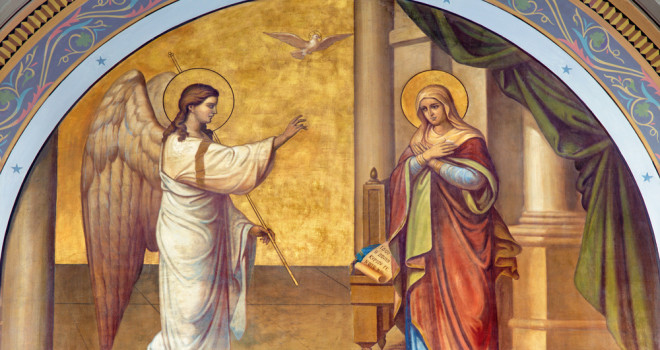
In our text this evening from Luke 1, we hear of this promise being fulfilled. The angel Gabriel was, once again, sent by God. This time, he was sent to a young virgin named Mary. She was betrothed to a man of the house of David named Joseph. Though they had not yet come together, she would conceive and give birth to a son who would reign over the house of Jacob forever. This visit of Gabriel to Mary is called the Annunciation, and here the Lord makes true His promise to save His people from their sins.

I.

For our Advent midweek services this year we are working our way through Luke 1, recalling the announcements of John and Jesus’ birth, and also the visit of Mary to Elizabeth. Last week, we heard the announcement of John the Baptist’s birth. His parents, Zechariah and Elizabeth, were well-advanced in years and, moreover, were barren. While Zechariah was in the temple offering incense to the Lord, Gabriel appeared and told him that their prayers had been heard. His wife Elizabeth would conceive and give birth to a son, and they would call his name John. Gabriel said, this child would bring great joy to his parents and to all people, for he is the forerunner of the Lord. With this word to Zechariah, the Lord was at work hearing and answering the prayers of His people. In our text tonight, He is beginning the work of our salvation. 

Six months after Elizabeth had conceived John the Baptist, Gabriel was again sent by God. This time he went to a city in Galilee called Nazareth, to a virgin betrothed to a man of the house of David; her name was Mary. Gabriel said to her, “Greetings, O favored one, the Lord is with you!” Mary was troubled by this – as, often in Scripture, seeing an angel is distressing – and began trying to figure out what sort of greeting this was. Gabriel encouraged her, for – by faith – she had found favor with God. Then, Gabriel said, “you will conceive in your womb and bear a son, and you shall call His name Jesus. He will be great and will be called the Son of the Most High. And the Lord God will give to Him the throne of his father David…and of His kingdom there will be no end.” 

Mary asked Gabriel how this would all happen, since she had not known a man. Gabriel answered, “The Holy Spirit will come upon you, and the power of the Most High will overshadow you; therefore the child to be born will be called holy—the Son of God.” The child which she would carry and give birth to would be no ordinary child, but the very God of very God – in the flesh. Gabriel gave Mary a sign that this would surely come to pass. He said, “Behold, your relative Elizabeth in her old age has also conceived a son, and this is the sixth month with her who was called barren. For nothing will be impossible with God.” After these words, the angel departed.

II.

Now, the question we Lutherans always ask – as Mary did in the text – is, what does this mean? What does it mean that Mary would conceive and give birth to a son named Jesus? Well, it means that God remembers and keeps His promises. The Lord is not subject to time and its decay. Rather, all time to God is as the present is to us. He is at the same time able to make the promise to Adam and Eve and begin fulfilling it here, at the Annunciation. The Annunciation is also the time where Christ’s Incarnation begins. As in the Lord’s Supper, the Word makes the elements the true body and blood of Christ, so also at the Annunciation the Word of the Lord spoken through Gabriel causes Mary to conceive. The name Jesus signifies the purpose of this event. It means, “The Lord saves.”

As we consider the meaning of the Annunciation, we should also consider the depth of our God’s great love for us. The God of God, the Light of Light, the very God of very God who was begotten of the Father before all worlds, entered into our world by taking on our same flesh. He submitted Himself to be born of a humble virgin to become like us in every respect. He entered into His own creation not to rule it, but to serve it – giving His life as ransom for us. And, it all begins, with the word spoken by Gabriel to Mary. The Holy Spirit worked through that Word, and Mary conceived Him whose birth we’ll celebrate in just a few short days.

At the Annunciation, the Lord showed that He is able to remember and does keep His promises. He first announced to Adam and Eve that He would send an offspring to rescue them from sin and death. Through Isaiah, He announced to King Ahaz that this offspring would be God-in-the-flesh and born of a virgin. Through Gabriel, the Lord announced that Mary was the virgin, and her Son Jesus would save us all. Thanks be to God. Amen.

What was Written in Former Days

Text: Romans 15:4-13

St. Paul wrote in his second letter to Timothy: “But as for you, continue in what you have learned and have firmly believed, knowing from whom you learned it and how from childhood you have been acquainted with the sacred writings, which are able to make you wise for salvation through faith in Christ Jesus. All Scripture is breathed out by God and profitable for teaching, for reproof, for correction, and for training in righteousness.” St. Paul reminded Timothy there of what he had earlier written to the Romans in our text today.

At some point during your confirmation classes and probably at a number of Reformation Sundays services you’ve attended over the years, you’ve heard of the three solas that we Lutherans confess. They are Sola Gratia, Sola Fide, and Sola Scriptura. In English: grace alone, faith alone, Scripture alone. We believe that we are saved by God’s grace alone, through faith in Christ alone, and that the Scriptures alone are necessary for salvation. But, what does that mean – that the Scriptures are necessary for salvation? What does the Bible do? What is it for? St. Paul teaches in our text that the Scriptures were written so that, through them, God would grant us teaching, endurance, and hope.

I.

When we read the Bible, we most often read it in English – because we speak English. We read it in English with nice little divisions into chapters and verses. These make it easier to read, but for much of the Church’s history there was no such thing as chapter and verse. For example, though by Luther’s time the Scriptures had been divided into verses, it wasn’t widely adopted until after his death. So, when Luther cited the Scripture in his writing, he most often just cited book and chapter. These divisions make it easier for us to understand the Scriptures, but they sometimes get in the way. Sometimes, as in our text today, the author is continuing a point from earlier in his writing, but the chapter divisions make us think we’ve moved onto a new topic.

Today, St. Paul’s teaching is continuing on from what he wrote in chapter 14. One of the issues among the Roman congregation came about because they were a diverse group. Diversity was not the issue, but what was, was that those who had converted from Judaism were not of the same mind when it came to the Scriptures. Some held that, though they were now Christians, they should hold to the traditions, feasts, and customs they grew up with. Others, believing (correctly) that these were fulfilled in Christ, no longer celebrated them. The problem: those who didn’t keep the traditions belittled those who did. St. Paul encouraged the “strong,” as he called them, to bear with those new to the faith. He said, “We who are strong have an obligation to bear with the failings of the weak, and not to please ourselves. Let each of us please his neighbor for his good, to build him up.”

But, then, St. Paul pivoted to how we should view and use the Scriptures, why they were given us. He wrote, “For whatever was written in former days was written for our instruction, that through endurance and through the encouragement of the Scriptures we might have hope.” The Scriptures were written not to be used as a cudgel to strike and divide, but, first, for our instruction. The Scriptures were written so that we might hear the Good News of Jesus Christ. Though the Holy Spirit first delivered the message through the prophets by spoken word, our Lord directed it to be in writing so that we could receive it 2,000 years later. Through the Scriptures we hear that Jesus Christ, fully God and fully man, bore our sins in His flesh on the cross. When He made payment for our sins, He then rose from the dead to restore to us eternal life. These things – forgiveness and eternal life – He gives to us now by His grace, through faith, when we hear it from Scripture and believe.

II.

The Scriptures were written, first, for our instruction. By the Holy Scriptures we hear the Good News of Jesus Christ, and the Holy Spirit creates faith through these simple pages. From the Scriptures we teach and raise our children to know Christ and His love, and then how to love and serve their neighbor. From Scripture – and Scripture alone – we receive all Christian doctrine. God has given us the sacred writings for, “Teaching, reproof, correction, and training in righteousness,” as St. Paul wrote to Timothy. But, that’s not all the Scriptures are for. “For whatever was written in former days was written for our instruction, that through endurance and through the encouragement of the Scriptures we might have hope.”

The Scriptures were also written so that through them God might grant us a patient endurance and encouragement. Luther speaks about this very well. He said once, “Scripture does not remove adversity, suffering, and death; indeed, it foretells nothing but the holy cross—St. Paul calls it ‘the word of the cross’…But this is what it does: In the midst of suffering it comforts and strengthens, so that our endurance does not break down but perseveres and conquers. It makes the soul very comforted, bold, and happy to suffer when it hears a comforting word from its God, that He is with it and sides with it.” What this means is that the Scriptures were written not for the sake about whom they speak, but for our benefit. 

This means that when we are suffering, we can look to the Old and New Testament saints and find in them fellowship. When we are suffering, we can look to Scriptures and see that, in our suffering, we are united with our Lord. He it is, who suffers with us. The Scripture were written so that we might find in them, and receive from God through them, endurance and encouragement. For, not ever in all of Scripture, did God abandon His faithful children. Not once, did God fail to preserve and deliver His beloved children. Nor will He fail to preserve and deliver us from all sin and eternal death.

III.

Through the Scriptures, the Lord delivers to us the Good News that our sins are forgiven by His grace through faith in Christ. He also gives to us the encouragement that, as He was with the saints of old, so He is with us. He Himself has said, “I will never leave you nor forsake you.” The end result, then, is that we have hope. That is one of the themes of this Advent season. We have hope that our Lord Jesus will come to us on the clouds. He will raise our bodies and change them to be like His imperishable body, and we will live with Him and all Christians in eternal joy and happiness. If it should be the Lord’s will that we die before His return, we know from the Scriptures that we can die in the peace of sins forgiven and the joyful hope of our new life in heaven.

Sola Gratia, Sola Fide, and Sola Scriptura. Hopefully, we all got a chance to learn these in our confirmation classes or over the Reformation Sundays we’ve been to in our lives. We believe that we are saved not by our works – not even a smidgen – but entirely by God’s grace through faith in Christ. This faith, He gives to us by the Holy Spirit through the written Scriptures alone. We learn from St. Paul today that the Scriptures are God’s instrument; through them He grants to us teaching, endurance, encouragement, and hope. Amen.

The One Coming in the Name of the Lord

Sermon Audio

Text: Matthew 21:1-9

Lift up your heads, O gates! And be lifted up, O ancient doors, that the King of Glory may come in. Who is this King of Glory? The Lord, strong and mighty, the Lord, mighty in battle! Lift up your heads, O gates! And lift them up, O ancient doors, that the King of Glory may come in.” These words of King David in our psalm were written, perhaps, for the return of the Ark of the Covenant to the tabernacle in Jerusalem. Because of Israel’s unfaithfulness, the Lord allowed His ark to be captured by Israel’s longtime enemies, the Philistines. It remained among them for a time, until the Lord heard and answered the prayers of His people – that He would dwell among His people once again. Therefore, David and all the people sang for joy in confidence that the Lord was with them, yet again.

From the rest of Scripture, we learn that the Ark of the Covenant, which represented (and was) God’s presence among His people, is fulfilled in Christ. Jesus Christ, the eternal Son of God – begotten of the Father before all eternity – entered into His creation to redeem it – us – from all sin and death. And the way He did that is in a way wholly different than the world would expect. Jesus humbled Himself to be born of a virgin, and then bore the punishment of all mankind’s sin in Himself. By His humble submission to death on a cross, our sins were paid for. The same humble Son of God who bore our sins on the cross, comes to us – even now, in this new year – in the humble means of His Word and Sacrament. Through these things, He sustains us until the time when He will come again in glory.

I.

Our text this Sunday, the first of a new Church Year, the first in Advent, is from Matthew 21. The English word Advent comes from the Latin phrase Adventus Domini, which means, “the coming of the Lord.” In the season of Advent, we confess what is called the threefold coming of Christ. We believe that He came to us, first, in His incarnation of the Holy Spirit and the Virgin Mary. We believe, second, that He comes to us now in His Word and Sacraments. And, we also believe that He will come again on the Last Day. In these things, Jesus shows Himself to be unlike any other king. He, who is the creator and possessor of all things, went into Jerusalem that Palm Sunday, knowing what would happen only five days later.

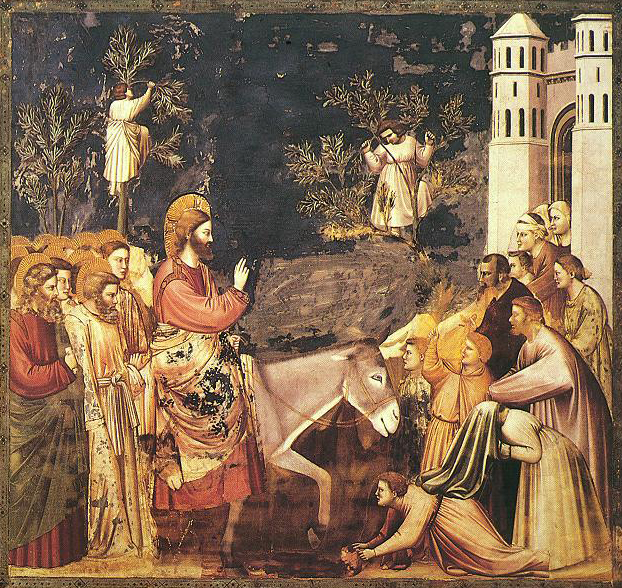
In our text, Jesus sent two of His disciples ahead of Him into the village of Bethphage. He knew that when they got there, they would find a donkey tied and her colt with her. He knew that someone would stop them and that they should say to him “The Lord needs them,” – and he would send the donkey and colt. Jesus knew that the large crowd going before and after Him would change over the course of the week. Many would leave Him or be convinced to asked for Barabbas’ release instead of His. He knew all these things – that He would die – so, why did He go? Jesus rode into Jerusalem so that these words might be fulfilled, “Say to the daughter of Zion, ‘Behold, your King is coming to you.’”

Jesus came unlike all the other kings of the earth. He came to not be praised or to be served, but to serve and give His life as a ransom for many. He came in perfect meekness and humility, neither breaking off the bruised reed nor snuffing out the smoldering wick. He came not to demand homage, but to be obedient in all the ways that we have disobeyed and strayed from the Lord’s Commandments. He came to suffer and die on the cross for your and my sin.

II.

The true King of Glory came into His creation by His humble incarnation and birth some 2,000 years ago. Yet, on the mount of His Ascension Jesus made this promise, “Behold, I am with you always, to the end of the Age.” His last words to us on earth assured us of His continued and continual presence among His people. The way He remains among us is not in some incredible or bombastic way, but in a way keeping with His Incarnation. Just as our Lord came to us, first, in humble flesh and blood, He comes to us now clothed in humble Word and Sacrament. Jesus created these and gave them to us so that the words, “Behold, your king is coming,” would be forever true for you and me. Jesus gave us these things, and He will never tire of being present among us through them. 

We poor sinners grow both cold and bored in our faith, at times we walk away; but our Lord never tires of forgiving us – even after 2,000 years of dwelling among His people. He comes to us daily and weekly to bring to us the forgiveness of sins which He won on the cross. In the washing of Holy Baptism, He joins us to His own death and resurrection and gives us entrance into His eternal life. Through His Supper, He gives us His true body and blood for the forgiveness of sins, and the strengthening of our faith and love. In His Word, in the words of Absolution, and in our Christian conversations with each other, Christ, by His Holy Spirit, keeps true His promise to forgive and be with us always. Though the world may look at these things as items to be discarded or – at best – as things which are not essential, we know that there is no greater treasure on earth than what our Lord has given us in His Word and Sacraments.

III.

2,000 years ago, our Lord entered into His creation clothed in humble flesh and blood. He bore in Himself the guilt of our sins, and the wrath of God which we deserve was poured out on Him. As the world’s true king, He came only to serve. He continues to serve and be with us now in this new year through His Word and Sacraments. Through these means of grace, He gives to us the forgiveness which He won on the cross. By these things, He binds up our wounded and broken hearts, He strengthens our faith by pointing us to Himself, and increases our love for each other and our God.

In this Advent season we confess not only our Lord’s coming in the flesh and His coming to us now in His means of grace, but we also confess that someday soon He will come again in great power and glory. Soon, the King of Glory David spoke about in the psalm will come on the clouds to judge the living and the dead. By God’s grace, through faith in Christ, our names are already written in the Book of Life and we will enter with our Lord and King into the joy of the new creation. 

Lift up your heads, O gates! And be lifted up, O ancient doors,” David sang, “that the King of Glory may come in. Who is this King of Glory? The Lord, strong and mighty, the Lord, mighty in battle! Lift up your heads, O gates! And lift them up, O ancient doors, that the King of Glory may come in.” The words were fulfilled in our Lord’s humble entrance into Jerusalem to suffer and die for us. Even now, in this new church year, the Lord comes to us in His humble Word and Sacrament. And, someday soon, the ancient foundations of the earth will be shaken as the King comes in all His glory to gather us to His side.

Let us pray:

Stir up Your power, O Lord, and come, that by Your protection we may be rescued from the threatening perils of our sins and saved by Your mighty deliverance; for You live and reign with the Father and the Holy Spirit, one God, now and forever.

The Coming of the Son of Man

Sermon Audio

Text: Mark 13:24-37

Jesus said, “Concerning that day or that hour, no one knows, not even the angels in heaven, nor the Son, but only the Father. Be on guard, keep awake. For you do not know when the time will come.” These words, along with our text last week – as I said last week – are easy to get caught up in. Last week, our Lord taught about the signs of the End of the Age and the time of His return. He said that there would be wars and rumors, famines and disasters. There would be continued and increased persecution of His followers. Nevertheless, nothing will happen which is outside of His control, nor will we ever slip out of His care.

If you take last week’s text and this week’s and put them together, it’s easy to become distressed. It is true, as we say in the creed, that Christ will come to judge the living and the dead. It says in the Athanasian Creed, “those who have done good will enter into eternal life, and those who have done evil into eternal fire.” It’s easy to hear these words and become afraid. But, to do so would be to miss the point. As Christians, we know that our names are already in Christ’s book of life by faith in Him. By the working of the Holy Spirit within us good works are produced in our lives, and we aren’t afraid of being locked out of heaven. Christ’s return will be a joy for us, so He encourages us today to watch and wait.

I.

Our gracious Lord and master Jesus Christ suffered for our sins on the cross. He died and rose again for us on the third day. Forty days after the Resurrection, after proving Himself alive by many examples to many people, our Lord ascended to the right hand of God the Father. The Apostles stood beneath Him as He was carried up into the clouds, gazing into the sky. While they were watching, two angels appeared and stood next to them, saying, “Men of Galilee, why do you stand looking into heaven? This Jesus, who was taken up from you into heaven, will come in the same way as you saw Him go into heaven.” The angels reminded them of what our Lord taught them today. Though He would be parted from them for a time – according to the flesh – He would return for all His faithful followers. And, He’ll come in the same way He left, on the clouds. St. Paul adds that He will come with the voice of an archangel and with the sound of the “trumpet of God.”

Before this happens, Jesus said, “the sun will be darkened, and the moon will not give its light, and the stars will be falling from heaven…the powers in the heavens will be shaken.” These signs are in addition to the ones Jesus spoke about last week, but with one difference. The things Jesus spoke about last week are meant to teach us that we have been in the End Times since the Incarnation. They are general signs of the state of things. The signs Jesus speaks of here will immediately precede His return. What exactly they will be like, we don’t know. But, their purpose will be to remove all doubt as to what is happening. It will not be a mystery to us whether our Lord is returning at that moment or not. About these things, Jesus said, “When [they] begin to take place, straighten up and raise your heads, because your redemption is drawing near.”

And so, it will be. Jesus said, “[Then, the Son of Man] will send out the angels and gather His elect from the four winds, from the ends of the earth to the ends of heaven.” At the last trumpet, our Lord will descend on the clouds. He will raise us, and all the dead. He will change our perishable bodies to be like His imperishable body. He will remove from our flesh all sin and weakness, all suffering and sickness, and we will enter with Him into the joy of the new creation. St. Paul said, “and so we will always be with the Lord.” At our Lord’s return, we will be raised to new life, forever separated from all death and sin. For the faithful in Christ, His return will be a joy.

II.

Our Lord’s return will be a joy for us, this we know; but what we don’t know is, when it will be. Therefore, Jesus said, “Be on your guard, keep awake.” Our Lord has seen fit to give us general signs of His return, so that we might recognize the times and be encouraged in our witnessing to others. Beyond that, it is not for us to know. Our God is patient and kind, not willing the death of anyone – but that they turn from their sin and live. But, someday, His divine patience with sin and unbelief will end. He will no longer restrain wind and wave as He always has. Creation itself will revert into chaos as it prepares for its undoing. Those who live in unbelief will begin to despair and become perplexed at these things, St. Luke records. We will be tempted to do the same.

Jesus said, though, that we should learn a lesson from the fig tree. When its branches become tender and put out leaves, it means summer is near. So, also, when all these things are happening, we know that He is near. As summer brings joy and life, so also our Lord’s return for His faithful. Jesus also said it is like a master who goes away on a journey, who leaves behind responsibilities for his servants until his return. Our Lord is the master who has given us the task to share His word with the world. In His Word we find life – the forgiveness of our sins and salvation. Jesus encourages us to keep awake, be alert, and be at work hearing and sharing His Word.

The words Jesus uses to encourage us to be on guard and keep awake are imperatives, they are commands; but our Lord never demands from us what He doesn’t also supply. Our Lord commands us to be alert and awake, and He gives us the means to be so. We call them the Means of Grace. The Means of Grace are God’s Word, the Sacraments, and the mutual conversation of Christian brothers and sisters – that is, when we encourage each other as Christians, pointing one another to Christ and His love for us. Through these things, the Lord creates and sustains faith in us. By them the Lord keeps us awake, to keep watch and expect His return. For us, His return will be a joy. He will come on the clouds, raise our bodies, change them to be like His, and bring us to His side forever.

With that, we come to the end of another Church Year. In this year the Lord has blessed us with the forgiveness of sins and with everything we need to support this body and life. Though the events before His return might seem frightening, we know that all things are in His care and keeping. Therefore, we close this year in peace and confidence, expecting with joy our Lord’s glorious return. Amen.

Rich Toward God

Sermon Audio

Text: Luke 12:13-21

There’s an idea that’s come up a few times in conversations and Bible studies these last few weeks. The idea is this: the more possessions a person has, the less thankful toward God they tend to be; the fewer possessions a person has, the more thankful they tend to be. Now, this isn’t a universal rule, nor is it a sin to have possessions. It just seems that the Old Adam sometimes has a field day with our possessions, and the more of them we have, the more we tend to focus on the gifts rather than the Giver of said gifts.

We learn from the Scriptures that we are saved by God’s grace through faith in Christ. God the Father sent forth His only-begotten Son to bear our sins on the cross and restore us to life through His resurrection. God the Father is our father through faith in Christ. Through this faith in Christ, we are made rich toward God. In addition, God, as our loving Father, provides everything we need to support this body and life. Often times, He even provides us more than we need. Through faith in Christ we made rich toward God and caused to receive His blessings with thanksgiving.

I.

Our text this evening begins with a man asking Jesus to settle a dispute between him and his brother. St. Luke wrote, “Someone in the crowd said to [Jesus], ‘Teacher, tell my brother to divide the inheritance with me.’” At this point in the Gospel, a crowd of many thousands was following Jesus. They knew Him to be an authoritative and well-spoken rabbi – a teacher. It was not unusual at the time to consult a rabbi in such a dispute. In the centuries after Jesus, certain rabbis would actually travel to settle arguments like this one; but not Jesus. He who would forsake all earthly possessions by His death for us on the cross, would not arbitrate an argument over inheritance, no matter how legitimate the claim may have been.

Instead, Jesus took the opportunity to pivot and teach what our proper attitude toward earthly possessions should be. He said to the crowd, “Take care, and be on your guard against all covetousness, for one’s life does not consist in the abundance of his possessions.” As Jesus says elsewhere, our life consists of more than we have, eat, wear, or buy. Our lives, first, are inherently valuable because we are created by God in His image. We find and are assured of this – our worth – by faith in Christ. But, when we seek meaning in possessions and wealth, we fall into covetousness – because there is never enough. And covetousness is idolatry. 

Jesus illustrated this with a parable. He said that there was a certain rich man whose land produced plentifully, so he thought to himself what to do with such an abundance. After conferring with his own conscience, he decided to tear down his barns and build bigger ones. That way, he could eat, drink, and be merry for many years. That same night God demanded his soul from him, and all his merry plans went to nothing. Jesus explained, “So is the one who lays up treasure for himself and is not rich toward God.” 

The point of the parable is that all that the man had came as a blessing from God. He could no more have caused his land to bear plentifully than he could’ve caused it to rain. Instead, God blessed him more abundantly than he ever needed. But, rather than consider how to use this abundance to be a blessing to others, the man thought only to bless himself. He thought only of his own happiness and had no sense of thankfulness nor concern for the poor. The man placed the gift in the Giver’s place, and was rich toward himself but not God. When his soul was demanded of him that night, he had to give account to God for pursuing only his own happiness. With this negative example, Jesus teaches us to be rich toward God.

II.

But, what does that mean – to be “rich toward God?” St. Paul wrote to the Corinthians in the chapter before our reading tonight, “For you know the grace of our Lord Jesus Christ, that though He was rich, yet for your sake He became poor, so that you by His poverty might become rich.” To be rich toward God is to receive the richness, the righteousness, of Christ through faith. Though Christ possessed all the riches and glory of the world – as the creator of the world – He set it all aside so that, in Him, we who are poor in sin might be rich in salvation – which we receive by faith. Remember the parable of the Rich Man and Lazarus. The rich man had all the world’s wealth, but was found to truly be poor while Lazarus – who lacked all worldly goods – was found to truly be rich in faith. 

We who were born spiritually poor and dead in sin, are made alive together with Christ and by faith in Him are made rich toward God. And, being rich in faith toward God, we recognize from Scripture that all that we have comes from His fatherly hand. We have neither earned the things we have nor have we deserved them, but God gives us all things out of His fatherly, divine goodness and mercy. Through faith in Christ, the Holy Spirit brings us to recognize this and receive all things with thanksgiving.

Like the rich man in the parable, God does often also bless us with more than we truly need or can use. Being rich toward God through faith in Christ leads us to receive what God gives with thanksgiving and to use it in the same. In the parable, when faced with such an abundance of fruit, the man should have thought how to use it as blessing toward others. We should do the same. When God blesses us with more than we need, we should see that as an opportunity to care for others – which is actually, God caring for them through us. God has often blessed us through the abundance given to others, and He blesses others through the abundance given to us.

Tonight we gather to give thanks to God for our daily bread. More than that, we recognize that, through Christ, God has provided us with more than we ever truly need. He is always more ready to forgive than we to ask, and to give more than we to receive. When blessed with an abundance, the man in the parable thought only of himself – for he was not rich toward God. Through faith in Christ, we who were poor are made rich in salvation. Our sins are forgiven. We learn from our text, that we should receive our blessings with thanksgiving and use them to be blessing to others. As it is written, “He has distributed freely, He has given to the poor; His righteousness endures forever.” Amen.