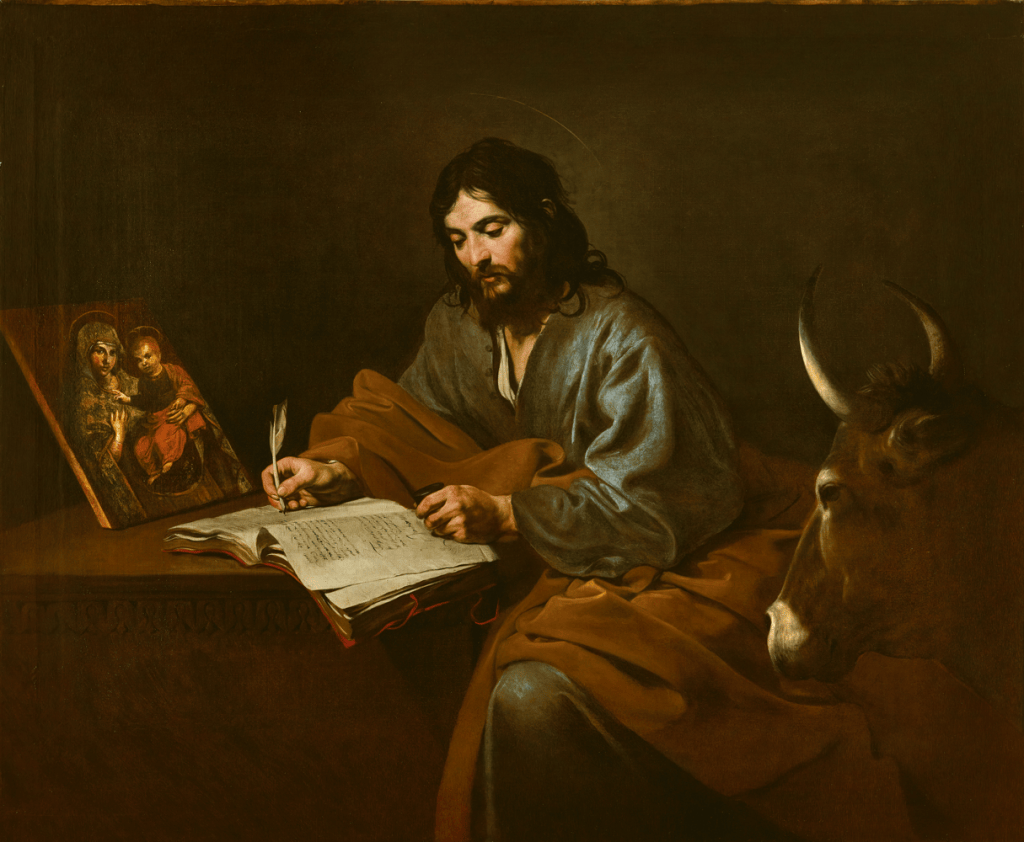
Today we give thanks for Saint Luke, the evangelist, author of his gospel and the Book of Acts of the Apostles. More specifically, we thank the Lord for giving us Blessed Luke. He was a physician by trade, but he traded it all to proclaim the one true physician of body and soul. We give thanks to the Lord that He has chosen a select few throughout the history of God’s people to record the mighty acts of God under the inspiration of the Holy Spirit.
In the dedication of his gospel, Saint Luke explains why he sits down to write. He wrote his gospel and, likewise, the book of Acts for us, so we can have eternal confidence that salvation rests entirely on Jesus Christ, who has fulfilled what was written for us. He writes in chapter 1, verses one through four of the gospel: “Inasmuch as many have taken in hand to set order a narrative of those things which have been fulfilled among us, just as those who from the beginning were eyewitnesses and ministers of the word delivered them to us, it seemed good to me also, having had a perfect understanding of all things from the very first, to write to you in orderly account that you may know the certainty of those things in which you were instructed.”
Through his instruction to us, we know so many things that only this evangelist records, because the eyewitnesses he speaks of told him these things that pointed us to Jesus Christ. Only through Luke’s Gospel do we know the miraculous birth of John the Baptist, born to Elizabeth in her old age. Only in Luke do we know that the angel Gabriel gloriously announced to the Virgin Mary that the child in her womb was from the Holy Spirit. Only in Luke’s account do we find many beloved parables, such as the prodigal son, the Good Samaritan, and the Rich Man and Lazarus. And miracles, such as the healing of the Ten Lepers. And finally, only in Luke, we have the beautiful account of the disciples on the road to Emmaus. I mention these details that are specific to Luke because his gospel makes clear that to know the church is to know our Lord and Savior, Jesus. This means that remembering the stories of the gospel is not the end of faith; the end of faith is knowing that the Lord Jesus Christ is present in the Church through the sacraments and in His ministers.
I. Saint Luke did not decide to write a gospel just so we would know something the others did not provide. Luke writes so that faith would be created in us. True Christian faith is not satisfied with simply knowing there was a man named Jesus who walked the Earth, performed miracles and signs, taught, and was crucified and raised to life. We can know these things by reason, since plenty of historical documentation outside the Gospels shows they did take place. Yet God’s Word reports them to point us to the church, where Christians receive the forgiveness of sins and the promise of everlasting life daily and richly. Therefore, the Word of God is not content with the faithful knowing what it says, but with receiving what it testifies to. And these scriptures testify to Jesus Christ among us in the confines of His holy Christian church.
Christ Jesus Himself established the church for sinners to be reconciled through the preaching of the Word, baptized in the waters of regeneration, and fed and nourished by His holy and precious body and blood given for us on Calvary’s Cross. This is precisely why Christ Jesus sent out the 72. To proclaim the kingdom of God and Christ’s presence among us in his holy church. These men are not sent by their own authority; they are sent with Christ’s authority. As we see later in Luke chapter 10, verse 17, those who were sent by Christ come back to Jesus to speak of what they have done in His name. Those 72 apostles say to Him, “Lord, even the demons are subject to us in Your name.”
II. As the Holy Spirit used the 72 men, their preaching of the gospel brought many more to believe in Christ Jesus as Lord and Savior. The office of the holy ministry is no man-made position. It is still how Christ chooses to bring us life in Himself. For without Christ and what he has established, there would be no church. Without the church, ministry, and sacraments, the gospels could not be applied to us or carried out in any way, because to hear the gospel is to receive the ministry of reconciliation. As Saint Paul writes in chapter 5 of his second letter to the Corinthians, the apostles and those of the office of ministry are “Ambassadors of Christ, as through God were pleading through us: we employ you on Christ behalf, be reconciled to God. For He made Him who knew no sin to be sin for us that we might become the righteousness of God in Him.”
Therefore, to know Christ in the gospel is to know reconciliation proclaimed by His ambassadors, our Lord’s ministers and apostles. The gospel reading shows us this: our Lord graciously provides laborers for the harvest so that the fruits of His suffering and death may be gathered, those of faith, into the barn of heaven, His church here on earth. It is the Word of God that is scattered across the ground, and still our gracious Lord chooses to use men to bring about His plan of salvation to all those who were elected to faith. God’s selection of apostles and ministers is not something He needs to bring about His plan. For there are those who come to faith in the Lord by the word of God alone, without preaching and the sacraments. Yet they are instituted for us that we may know the truth of what the Scriptures mean and how they speak to our sins and to our righteousness on account of Christ Jesus. Yet even those who have not heard of the ministry understand that Christ instituted the church for the good of those who believe.
III. It is by the Holy Spirit that Saint Luke and his fellow biblical authors revealed to us that wherever his gospel is read, proclaimed, and understood in its truth and purity, there will be the Church of Christ and the Lord’s Holy Ministry of Word and Sacrament. Likewise, wherever those things are carried out according to his word and promises, our Lord Jesus Christ is in the church. So if anyone asks you, “How do you know your God is true?” or “Why do you say your God is the right one?” We can say, “We have the church founded by Christ and grounded in His Word.” The church still stands because Christ is her head. Within that church, Christ Jesus shows us His love and mercy through the proclamation of his word and the Sacraments.
Only through the church do we come to know the deep corruption of our sins and the cost of our offenses. Only in the church are we promised a savior who has purchased us and redeemed us. Nowhere else can we hear Christ firm proclamation that our trespasses have been cast into the sea. There is none of our religion or man-made thing that can give us grace of God besides His holy Christian church. For no one else washes us of our sins in holy baptism. No other place do we receive food that strengthens the body and heals the soul: His own body and blood. Christ Jesus has promised nowhere else that He will never leave nor forsake those who believe in Him as Lord and Savior. This is what and where the Lord Christ promises, so you need not be in doubt. Amen.

