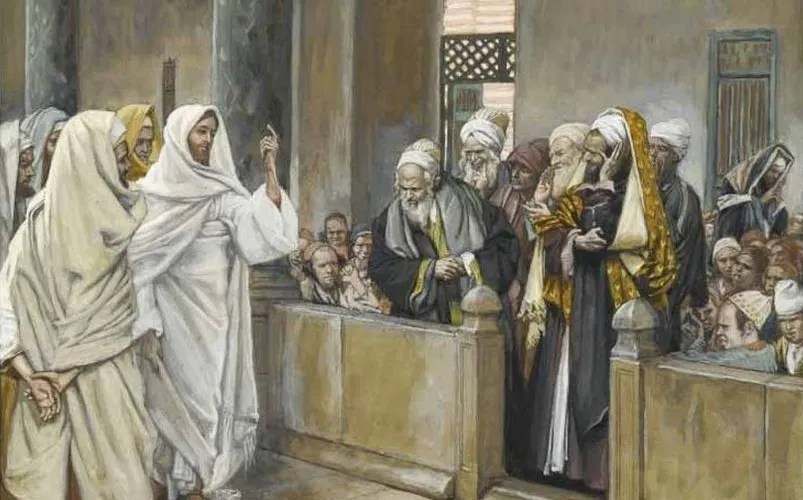
Today we see the stark contrast between how the Pharisees would like to understand the Bible and how Jesus Christ, the Word of the Father incarnate, the very author of the Scriptures, tells us how we must read His Word. The Pharisees attempt to bring Jesus into a debate that they have among themselves. The five books of Moses contain hundreds of commandments, yet they still want to know which is most important because they are not deep in their hearts; they fail to keep them. So the Pharisees make a point of keeping only the most important ones. They have to know the bare minimum because, for them, they wouldn’t be saved otherwise.
Our Lord shows that this debate among themselves is aimless. By asking, “Who is the Son and Lord of David?” the Lord puts an end to the squabbling. The Pharisees did not understand this question, for they did not search the Scriptures to find God’s holy Messiah; as Christ also says to them in John chapter 5, “You search the Scriptures, for in them you think you have eternal life; and these are they which testify to me.” Therefore, the whole of the Scriptures testify to Christ Jesus, the source of eternal truth.
I. There is a common question that arises when we discuss the Prophetic Word found in the Old Testament. For example, in the Scripture Christ cites as the words of David, recorded in Psalm 110, how could mortal David know something that had not yet transpired in human history: that the Messiah would come through his own lineage? The answer is found in how Christ presents this passage to them when He says, “David in the Spirit.” This, of course, must refer to our Lord’s Spirit, who proceeds from Him and the Father, the third person of the Blessed Trinity: the Holy Spirit. David did not know this in himself, but the words that he recorded were inspired by the Holy Spirit. God inspires not only the ideas and concepts presented in the Bible, but also the specific words each author uses to write the Word of God.
Therefore, what the Bible says is always true, because it does not come from human imagination but from God Himself. The Bible is true in two ways: first, as we have already discussed, it is recorded because the Holy Spirit inspired these men with the words to write. And Second, Jesus demonstrates they are true because they refer to Him, the very Son of God. The entire Scriptures are about the Lord Jesus Christ. This is what the Pharisees do not understand. They want to only know the bare minimum they must meet to be saved, and Jesus says, ‘You Sadducees and Pharisees have missed the entire point of the Law and all the Prophets.’ If they had not shut out the Holy Ghost from their hardened hearts, they would have seen that Christ Jesus is the fulfillment of the Scriptures. Yet, they did not ask Him any more questions because they desire to crucify the one whom Israel hoped.
II. So then, if Christ is the point of the Old Testament, and all the promises and commands are fulfilled and kept in the incarnate Son of God, Christ Jesus, does this mean that the Old Testament loses its authority? Or does the Christian have any obligation to it? No one would dare to say it in such a direct manner, for that would be an insult to God and what He has done through the patriarchs and the ancient Israelites. The question may appear in a subtler form, such as saying that the God of the Old Testament was full of wrath and condemnation, and only the God of the New Testament is merciful and forgiving toward mankind. Or to say something like I don’t care about the things of the Old Testament, like the Ten Commandments, because Jesus has removed their penalty from me. Or all I need is a couple of passages from the New Testament, and I can leave the rest.
When we speak of Christ’s fulfillment, we are not saying everything before Christ is erased. For if the Old Testament is about Jesus, how can we leave it behind? So when we read and study the Word of God, no matter where it is placed in our Bible, we must understand that God recorded these words because they report the forgiveness of sins through the crucified and risen Son of God.
Also, the Old Testament is not a set of fables that somehow point to Jesus. Fables are meant to point to an ideal or moral. Jesus is not a concept. He is a person. A true Man who walked the Earth, bore our sins, and was crushed by His Father. So if the Bible points to a real person, then the events leading up to Him are also historical by necessity.
Let me give an example. The theories of the Big Bang and evolution have brought great scandal upon the church, and have even stolen many away from true Christianity. These theories not only deny Genesis chapters 1 and 2, but also deny the person of Jesus Christ. And this is how, for in Genesis chapter 1 verse 3 it says, “Then God said, ‘Let there be light’; and there was light.” So, through God’s act of speaking, also known as God’s Word, the universe and all that is within it are created. That word in the beginning is Jesus Christ, as St. John begins his gospel like this: “In the beginning was the Word, and the Word was with God, and the Word was God… And the light shines in the darkness… And the Word became flesh and dwelt among us.” Therefore, the New Testament does not replace the Old, for if the Old Testament were understood to be non-historical, it would remove Jesus from Scripture entirely.
III. This means that we cannot look at the Bible in the same way that the Pharisees and Sadducees do, trying to decide what parts of the Bible are needed and which are not. Because of our fallen nature, we want to pick and choose the parts of the Bible that best suit what we think the Bible should say. Maybe it’s verses that only talk about God’s grace, verses that condemn the sin of others, but not our own, or removing verses that challenge us and make us feel uncomfortable. We might avoid those verses because they might cause offense or turn people away.
But if we never let the Word of God challenge us and the way we see ourselves and the world, we would not increase in our faith. We would not allow the Word of God to shape us. Instead, we would want to shape the Word of God to our liking. This would not benefit us. Of anyone in the entire Old Testament, no one knows how much the Word of God can be challenging and uncomfortable more than Moses. He was called by God in the form of the burning bush to go to Pharaoh and tell him to release his 3 million slaves to go worship in the wilderness. If Moses said to the Lord, ‘That makes me feel uncomfortable,’ the Bible would be a pretty short book of unkept promises. Yet God has a plan, and He will see it through.
Therefore, do not let the world’s opinion distract you from following the Word of God. The world did not die for our sins. Nor does it care about your best interests. Jesus Christ has fulfilled what was written; the Lord has removed our sins in His blood. Our Lord’s word has brought us new life, forgiven our sins, and saved us all for the sake of God’s Son.
Let us search the Word to find Christ and, by the Holy Spirit, be inspired to live by it. Amen.

