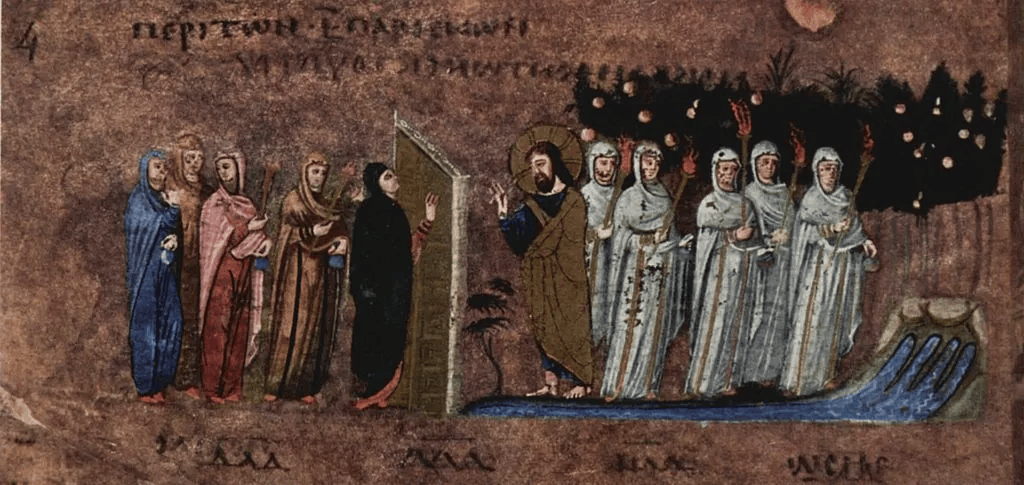
The gospel for the last Sunday of the church year reveals to us how the wise keep their lamps filled with oil; that is the life of faith, begun in Holy Baptism.
I. To understand the Lord Jesus’ coming again in glory, and why He uses this parable, we must know what these ten virgins have in common before we can distinguish the wise from the foolish. For all these have not only received the invitation of the Bridegroom, but they have also attended. Christ Jesus, the eternal Bridegroom from Heaven, extends this invitation to the archetypal wedding feast between God’s Son and the beloved bride, the holy Church of the elect.
So, how do these receive our Lord’s invitation? By means of the Church’s proclamation of Christ’s gospel on earth. Even before the foundation of the world, God foreknew and predestined that He would send His only begotten Son as the propitiation for the sins of the world. Hence, before Adam and Eve were even created, God knew He would work salvation through the sacrifice of the Son and extend it to all the world so they might believe and be restored to what was lost from the beginning.
In His Son, God reconciles the fallen world to Himself. Even in Adam’s disobedience, the entire world became corrupted, as sin and death came to all his descendants; much more, the grace of the one God-Man, Christ Jesus, the sins of all would be atoned for, and those who believe receive eternal life
What the Lord Jesus does on the cross is not only for a select few; the Christ does not die just for all who would possess eternal life in heaven. Yet Christ’s shed blood is sufficient for the sins of the whole world, both believers and unbelievers alike! As He pays for all transgression, the invitation to the wedding is meant for all people. The invitation of salvation was once proclaimed by the Prophets of Israel, the Apostles of Christ, and now by the Ministers of the Church, and even now the Church does not forget Her purpose: to bring countless to the wedding feast of the Lord.
Yet the parable’s aim is not the whole world, or even all who heard the Word of God at one point in time. Specifically, the parable is for those who have received the gospel, that is, the Word of God in its truth and purity, and still claim to be part of the Church Christian. For even the foolish ones hold the lamp close to their hearts. This lamp is nothing other than the Word of God itself, as the patriarch David says in Psalm 119: “Your Word is a lamp unto my feet.”As those who did not accept Christ in this life do not hold the Word of God sacred in their hearts and minds, this parable is only about those who are and claim to be Christians. Therefore, we, the Church on earth, must receive this parable of the wise and foolish virgins with joy and also remember the warnings it gives.
II. Now, on to what sets apart the wise and foolish virgins, representative of the Church of Christ on earth. It is based on the fact that the foolish ones are ill-suited to wait for the Bridegroom to come, and that the foolish did not have enough oil for their lamps. They all must have had oil at the beginning, but the foolish see no need to replenish it or, in other words, to watch over how much they have or lack. The oil is symbolic of the grace and gifts God, the Holy Trinity, has given to us in the Sacrament of Holy Baptism.
To be a Christian, a member of the Church of God’s grace, requires Baptism. Even Saint Paul connects the Sacrament of Baptism to being sealed in Christ with oil. As he states in Ephesians chapter 4, verse 30, “Do not grieve the Holy Spirit of God, by whom you were sealed for the day of redemption.” In the sacrament, we are sealed with the Holy Spirit of promise. For we are made temples of God by the Spirit, who dwells in us as begun in baptism.
Those who are foolish deny or reject what God has inaugurated in baptism, even though they have been given new life in Christ out of God’s pure, lavish grace, for concerning baptism, Saint Paul writes in Romans chapter 6 that “we were buried with him through baptism into death, that just as Christ was raised from the dead by the glory of the Father, even so, we also should walk in the newness of life.” Therefore, saying that the only purpose of baptism is the forgiveness of sins without sanctified life misrepresents all we receive.
Those in the parable neglect to receive from Christ the oil necessary to wait for His coming; they believe they have enough. Their only connection to Christ is that they were baptized some time ago, and they failed to realize they must remain in the state of baptism and constantly need to receive God’s grace through the Word and Sacraments. Those who forget to continually seek what God gives us in baptism: new life, the forgiveness of sins, and the promise of the Holy Spirit. They will eventually grieve the Holy Spirit altogether, and by doing so they pour out from the lamps God’s holy oil.
III. So what does that new life in our baptism look like for us, the wise ones who continue to seek God’s grace through Christ in His death and resurrection? That we, by God’s grace, cooperate with the Holy Spirit who dwells in us. And this indwelling of the Holy Spirit produces fruit, such as faith, repentance, and good works.
The first is faith: although our belief and trust in Christ as Lord does not begin within, it is given to us, credited to us, and we can claim it as our own. We trust in the Lord Jesus for His mercy and believe in His promise to bring us to eternal life through His own life and death.
Also, through repentance, by His grace, we know the corruption of our nature, as our sins of thought, word, and deed are manifold. And from repentance we strive against the sins that weigh us down. Though our fight against temptation is weak, we do not willingly surrender to the things that separate us from grace. Including forgiving those who have sinned against us.
And finally, our good works: these are the deeds, although tainted by sin, that we do out of love for Christ towards our neighbor and are pleasing to God, as Saint Paul writes in Ephesians chapter 2: “We are [God’s] workmanship, created in Christ Jesus for good works, which God prepared beforehand that we should walk in them.” These are the Lord’s will for us, as we hear in Luke 17: the faithful will say to the Lord, “We are unprofitable servants. We have done what was our duty to do”
IV. It is all merely by grace that we who are elect in Christ are to believe in His Son. The wise ones at the wedding are wise because they continued to seek from the Lord what He has promised. They do not bring anything of themselves. They simply fix their eyes on Jesus and His promise of coming again.
Therefore, do not worry whether you are wise or foolish. Set your eyes on Jesus; remain steadfast in what you received in baptism and in how God strengthens you through His word. What the Lord does through these things is more than enough. In Christ, our oil is filled, for He has prepared the wedding for those who rely on Him! Amen.

