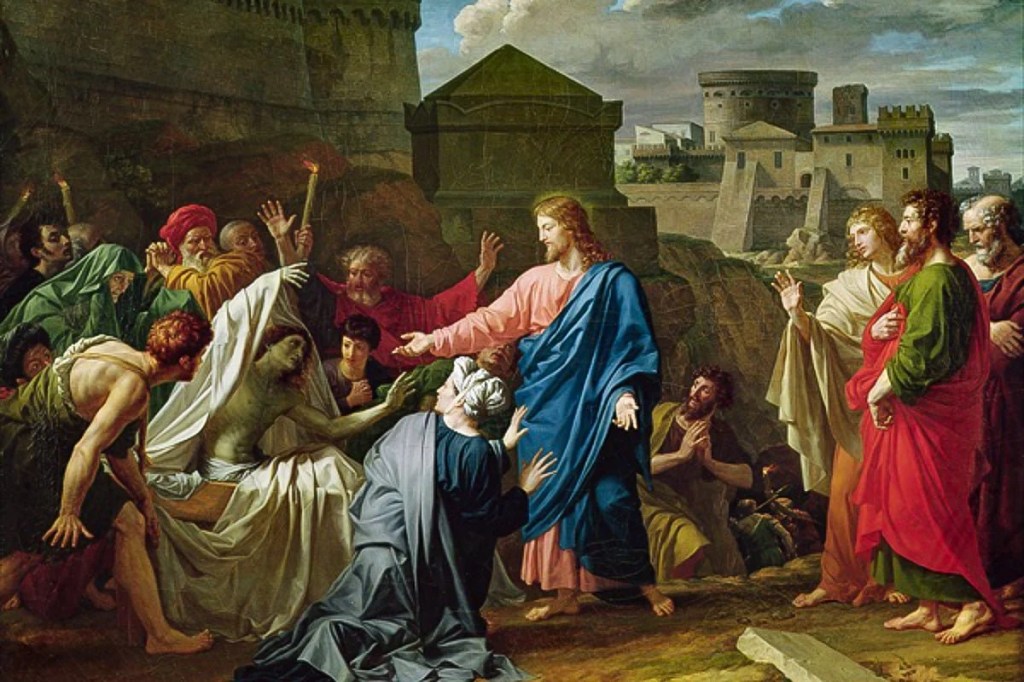
Elijah tells the widow of Zarephath, “Give me your son.” Within these four little words, we have the entire Christian theology of death. When we lose a loved one to any kind of disease or tragedy, we should see it as if Christ, the greater Elijah, were to come and say to us, “Give him to me.” For when a saint of God comes to their death, it is our Lord Jesus’ final call to turn away from the sinful world and to find peace in His nearer presence, where there is no death, sorrow, or crying, and where the Lord Himself will wipe every tear from their eye. As that is our Lord’s final calling to come unto Him, we can confess with the Psalmist: “Precious in the sight of the Lord Is the death of His saints.”
Our gospel reading proves this in three ways:
First, it is fitting for the Saints to have a proper funeral and Christian burial.
Second, the Lord does not forsake the mournful, especially the widowed and orphaned.
Third, we must go to our deathbed, believing that our resurrection is close at hand, even as we are led to our grave.
I. When Christ Jesus departs from Capernaum and comes into the village of Nain, He is greeted by death. Not death only, but also sin, as the wages of sin is death. Christ and the disciples see a procession led by a corpse and a coffin heading to a cemetery, a resting place outside the small village. Right behind the last of the pallbearers is his mother, who was already a widow. Her only son, who was supposed to take care of her until she died, is now dead himself. While the world would look upon these events as the most to be pitied, the Christian sees the greatest confession of hope.
For when a saint of God is laid to rest in the ground, it is the Christian way of saying to the world that death is not the end. For death, in its most fundamental sense, is the separation of the soul from the body. Upon our death, our souls will go to be with Christ for a time known only to God the Holy Trinity until the day of the final Resurrection, when our bodies will be raised to immortality, with no disease nor infirmities. The very same body we have now will be restored and glorified, and our righteous soul, which was with Christ from our death, will be reunited to dwell in the new heavens and new Earth for all eternity.
For when we are laid to rest, and our loved ones commend us to the ground and the Lord’s care, we do so in the confidence of our Lord’s word. For even the saints of old still rest in peace, for they are like seeds in the ground that will sprout up, bearing much fruit of righteousness on the last day. In the same promise, the patriarch Abraham, a visitor in a foreign land, still bought land to build a tomb for his beloved Sarah in Genesis 23. In Genesis 50, Joseph’s last words before his death were to plead that his bones be carried to the promised land to be buried with his forefathers. In John chapter 11, Lazarus, a friend of Christ, is buried in the tomb, for his sisters awaited the day of the Lord’s coming again. And of course, Christ was buried in a freshly cut tomb.
These are the examples presented to us by the Word of God as external confessions of Christian faith, and we still take comfort that Christian burial is not an absolute necessity for the Resurrection to life, for the Lord has promised to raise all men, those buried, whether in the land or at sea, or scattered upon the Earth, and to give those of faith their righteous award.
Also, the Christian funeral, whose sole purpose is the preaching of God’s Word, that is, although sin led to death, in Christ Jesus that death has been defeated in Him, in order that those who are living may likewise be prepared to be placed into the grave and to rise soon after. The funeral is our encouragement to keep the Christian faith that our loved one now waits for us in the presence of Christ.
II. In the raising of the son, we also see our Lord’s interest in the needs of the mournful, especially the widow and the orphan. The eternal Son of God becomes a man so that He may know in Himself the bitterness of sorrow and death. As the Lord Jesus mourns over his beloved friend Lazarus, Christ knows our own grief because the Father did not spare His Son either. Therefore, even as we wait in hope, our grief is not in vain. For if grief was necessary for Christ Jesus, we are truly blessed to be counted worthy to mourn with God’s only begotten Son.
Sorrow and grief over death are not something to be avoided or taken lightly, for the Lord uses them for our sanctification, which is God’s work through the Holy Spirit to conform us to the image of Christ. Trials and grief are not signs that God has forsaken us. Instead, they prove God is at work, equipping us for eternal salvation.
Until that day when all the dead in Christ are united in the kingdom of Heaven, our Lord does not cease to care for those in extreme need, as Psalm 68 verse five states: “[The Lord] a father to the fatherless, a defender of widows, Is God in His holy habitation.” The Lord will not forsake them, and He will not allow them to befall anything that He would not allow to befall His own Son; and still, as Christ Jesus was forsaken, we will never be forsaken.
III. As the Lord Jesus has compassion on the woman by raising her son and saving her from shame and poverty, we find our own consolation. We must go to our deathbed in the full conviction that our Lord Jesus Christ, who has already united us to Himself in Holy Baptism, is with us. For Saint Paul writes in Romans chapter 6, in the water and the Word, we have already died and have been raised with Him. If we have already died, our second death, the one that separates the soul from the body, should be no more intimidating than shutting our eyes to rest, as we will be awakened from our slumber by the joyful sounds of the heavenly trumpets, announcing Christ’s reappearance.
When our last hour comes, we need not hesitate or be dismayed. For in the death of Jesus Christ, your death is also holy and glorious in His sight. Your place of rest will be safe and secure, for He has shed His blood upon the Earth, the very blood that has won you eternal salvation. The Lord will remain faithful to what He has spoken of your body and soul. We will awake from that holy sleep and see our Lord Jesus, as the man saw Him on the way to the Earth. The Lord Jesus will say unto us, “Do not weep; I say to you, arise.” To God be praised forever, for He has visited His people! Amen.

