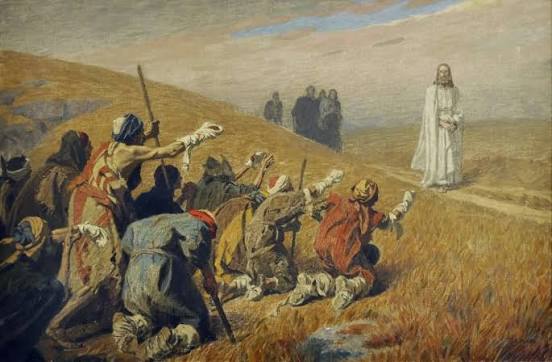
To be a leper is to be marked by God as an unrepentant sinner. For it has been recorded for us in the 12th chapter of the book of Numbers that Miriam and Aaron sought to lead a rebellion against their brother Moses, who faithfully led the people out of Egypt, because they no longer believed he was fit for the task the Lord had called him to do. In the eyes of the Lord, this was not only a rebellion against Moses, but against God Himself. As the Lord came to visit with judgment upon Miriam and Aaron from the cloud, the anger of the Lord rose up against these two. Leprosy was afflicted upon her that even her entire body was as white as snow.
In fear for her life, Moses cries out to the Lord. Miriam recovers from her illness only after seven days of being shut out of the encampment. Her being leprous was a work of the flesh that pointed to her sin of rejection of God’s work among the people of Israel in the appointed Moses. It was her own sin that cast her out as a rejection of her citizenship among God’s people, and by the intercession of the Lord’s appointed one she was restored to God’s saints, the nation of priests. By this account we come to see the Lord Jesus, who hears those who cried by faith and frees them from the leprosy of sin and affords heavenly citizenship to the elect in Christ.
Saint Luke does not divulge the cause of the leprosy of these ten men, yet like all diseases and infirmities, it is the result of the fallen state. The fruits of sin lead to the death of all men. Whatever their offenses may be, they all come to Christ in faith for His divine mercy. These unclean seek our Lord’s mercy of healing, not apart from His mercy of forgiveness. For Christ is merciful insofar as He forgives sins. The cleansing of their leprosy is therefore the result of the removal of their sin.
As the ten all possess saving faith in Jesus Christ, for no one can call for mercy from God if they do not believe. Christ Jesus does not turn them away, for all who seek Him will receive absolution, that is, restoration of the soul from the bondage of sin, death, and hell. As true believers in Christ, they are freed for the purpose of the true worship of God in the communion of Saints. In order for their citizenship to be reinstated so that they may live among God’s people once again and come to the temple, they must go to the priest. Their departure for the temple also demonstrates their belief in Jesus: they took Christ at His word, which was not vain speech. Instead, when Jesus proclaimed that they were cleansed of their infirmities, they took Him solely at His word and did as they were commanded.
We should have no doubt that they went to the temple, each and every one of them, and so after that only one from the nine, the one who has so happened to be a Samaritan, an outsider of the promises given to Abraham, returns. Why was it only one? An easy answer would be, ‘Well, this is the only one who truly had faith in Christ.’ In fact, they all possess faith in Jesus Christ, at least at first, as they receive healing through forgiveness and a desire to obey.
As the ten show themselves to the priest, all but one lose the desire to offer thanksgiving to Christ. In other words, it is this Samaritan who does not lose faith in the Lord, while the others are persuaded to forsake Christ and the spiritual gift of faith in Him for earthly pleasure and fame, as was undoubtedly the desire of the temple priest when they heard that they were healed by Jesus. The priests in this miracle are much like the world, our sin, and the devil. When faith in Christ begins to take root in us, those things will try to steal Christ away from us, especially at the very beginning.
Does this mean that saving faith in the Lord can be lost? Yes. This is what we are warned of in our reading from Galatians chapter 5. As Saint Paul tells us, the lusts of the flesh are against the Spirit, and the Spirit is against the flesh, meaning that, as they are contrary to one another, the things of God, granted by the Spirit, will fight against the temptations of the flesh. At the same time, our sinful condition will not respond without opposition. The new man, given to us in Holy Baptism, will always fight the hostility of the old Adam. When man allows their proclivity to overtake them, that is when we sin. This is the goal of the world and the devil: that we no longer repent; the outcome being that we do not return to Christ, as if we would be counted among the nine healed, those who rejected their heavenly citizenship.
Saint Paul continues to make his point as he lists the sins of the flesh that will bring about their purpose if they persist in unrepentance. Some of the sins named are obvious, while others seem as if they would be insignificant, but they are all the same in their intent. Such as lewdness, the use of vulgar or obscene language. Or sorcery, the dependence on spells and horoscopes over the one true God. Finally, outbursts of wrath or anger, which include violence and hatred for the fellow man. These are the sins that we must be watchful of, as they are how the world takes us away.
So we are instructed in the way of the Spirit, grounded in faith, as it is fixed on Jesus Christ. The faith that produces long-suffering, kindness, gentleness, self-control, and the like. For there is no such law that prohibits them, as we live by the Spirit; let us walk by the Spirit. Christian faith that trusts in the Lord continues to seek the glory of God of all grace and mercy by its fruits, and does not become distracted or persuaded by the things of the world. The one who desires to return to Christ to thank Him for the removal of their sins will do so and will not forsake Him.
For when we are forgiven and restored by God’s only Son, our Lord Christ, we are made well. Meaning that our old self, the one infested with sin and selfishness, is removed from us. As the works of the flesh are no longer counted against us, so we have been counted righteous for the sake of Jesus Christ. By divine grace, we will stand before the judgment seat of God, not as sickly outcasts; instead, we are made whole and so saved eternally and granted citizenship in the Kingdom of God, which we enter in body and soul at the Day of our Resurrection. Until that most glorious Day, we thank the Lord God for the benefit received through Christ, that He may both sustain us in faith and finally bring us to eternal life! Amen.

