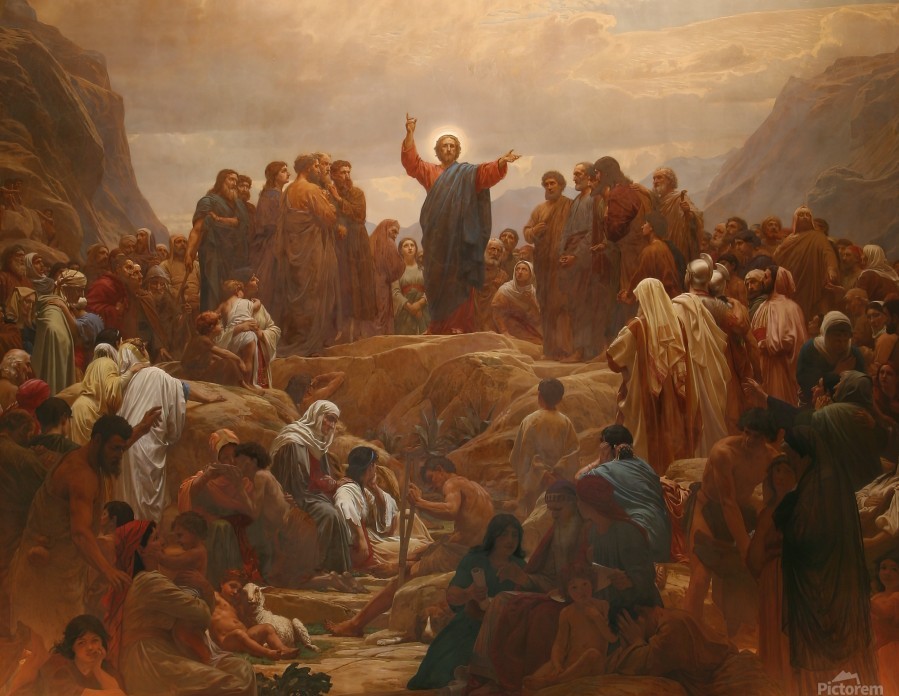
When the Lord Jesus says to the crowds at the Sermon on the Mount, “That unless your righteousness exceeds the righteousness of the Scribes and Pharisees, you will by no means enter the kingdom of heaven,” this seems to them as an unbearable task of good works and ritual purity. At the time of Jesus’ ministry, the Pharisees were seen as true Israelites and the perfect keepers of God’s law. They followed all the laws of Moses; they purified themselves with ritual washings before every meal; they did not eat with anyone who was impure; and the Pharisees did not have common jobs because they were too busy studying and debating the meaning of God’s Word among themselves. If you asked the common man during the time of Christ who was the most righteous in all of Israel, every single one would point to the Pharisees. And now Jesus tells the crowds that their righteousness must go beyond that of the Pharisees.
Then, in the remaining portion of our reading, Jesus explains that their righteousness is void before God. And this righteousness that the Pharisees pursue does not gain anything before God, as it is only for pomp and others’ approval. And so He points the crowd to the fifth Commandment, which the Pharisees have not kept: “You shall not murder.”
The Pharisees and our self-righteous sinful state would like to tell us that we have perfectly kept this Commandment if we simply follow the letter of the law. They say as long as we do not follow the actions of Cain, who killed his brother in the field, we have kept God’s Word enough to be righteous before the Lord. For the Pharisees, this command has nothing to do with anger toward our neighbor, cursing, hating them, or spite. Jesus clarifies this line of thinking by distinguishing between civil or secular righteousness and true Christian righteousness.
The first of these is worldly or civil righteousness. This kind can be determined through natural reason or simple logic that we should and ought not to harm anyone, but to do good to everyone. In other words, this is how the world defines what a good person is. And still being a good person in the eyes of the world is not enough to achieve the kingdom of God. Not a single person has gotten into heaven because they are good people. No one has received eternal life because they have never killed another person, or they give loads of money to their local children’s hospital, or they volunteer for the soup line. The Word of God still instructs us to have a good reputation with those outside the Christian Church. And yet, the righteousness bestowed upon us by the world is not the same as that which Christ gives us.
For we are saved by Christian righteousness, which is sometimes known as spiritual or inward righteousness. This one is granted to us by the Lord Jesus Christ through faith and the Word of God. Through this righteousness, we see the fifth Commandment, which we have not kept at all, for this commandment is more than a warning against physical murder. In this passage, Jesus teaches us that murder does not begin with the weapon in our hand, but with anger conceived in us. For anger begins in the mind when we think that if only that person were dead, or if only our neighbor could be struck with bad luck. This may lead to looking at our neighbor unkindly, not speaking to him, turning our nose up at him, or doing similar things, as if we were to say to him, ‘You fool.’ Then it can also result in angry words, such as openly cursing our neighbor, speaking evil of him, or trying to destroy his honor and good reputation. And finally, there is murder, which is the result of evil thoughts, angry actions, and verbal abuse when they are not coerced or restrained.
Therefore, out of Christian righteousness, the new man, strengthened by faith and the Word of God, sees sin crouching at the door, and, by God’s grace, we repent of evil and trust in the One who has delivered us from sin and destruction, so that we may rule over it. This, of course, is our Lord Jesus Christ, the fulfillment of the murder of Abel, whose blood is poured out on Calvary to speak for our righteousness. The Lord died in the most miserable way for our redemption. Jesus, the murdered, gives His righteousness to the murderers, sinful men, by trust in His Name. Those sinners who had fallen captive to the devil, who has been a murderer from the very beginning, are now reconciled through the blood of Christ, the very Lamb of God who takes away the sin of the world.
It is the righteousness given to us by Christ and Him alone that has saved us from the punishment of our sins and has granted us eternal life with Him. Meanwhile, the world would like to call us good because of our deeds, but God forever makes us righteous by what His Son has done for us. He has done what we cannot do, has paid the debt we cannot pay, and has washed us clean by His blood.
And so to that end, we have been called to a new life. A life of reconciliation and brotherly love. So, when we sense anger beginning to oppress us, we ought not to let it brew before it is out of control, for Paul says, “Do not let the Sun go down on your anger.”And so, ask your merciful Father for forgiveness, and if it has been put into action, go to your brother. For the Lord says, “Come to terms quickly with your accuser while you are still going with him to court.” And if your neighbor is unwilling to hear your repentance, your Heavenly Father does not reject you because of theirs. And so there is no need to waste a day, a week, or a year, for God waits for us to return to Him through Christ Jesus.
In that same spirit, we should not leave our neighbor in doubt of their forgiveness. Sin often cuts deep and is personal, but that doesn’t make you worthy to withhold Christ’s love given to you for your neighbor. Therefore, we ought to be ready at all times to forgive. So our neighbor who has left their sacrifice at the altar, that is their true worship of God, so that they may be reconciled in order to return. And through our acts of reconciliation, we are loving our Christian brothers so that they may join us in the worship of God and receive His grace and pardon here, and eternal life hereafter. Amen, amen.
 St. John's and Grace Evangelical Lutheran Parish