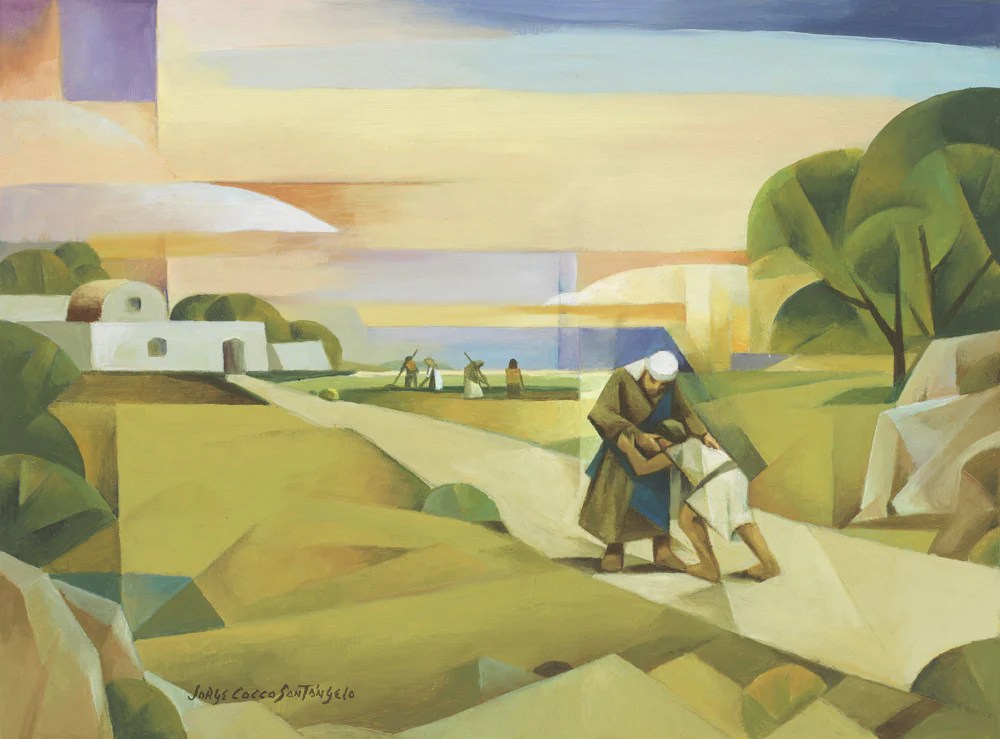
The commonly attributed title for this parable, “the prodigal son,” is misleading because it assumes that the father has only one son who has sinned against him. Instead, Jesus makes very clear that this man has two sons. The younger son, whom we all remember. He goes to his father to ask for his inheritance in advance, then goes out and spends it on reckless living. And the oldest son, the one who stays and does not accept the repentance of his own brother, and blames the father for showing love where it is undeserved. But that is what precisely our Lord desires to show us in this parable, that no matter our sins, the forgiveness and mercy we will receive from Christ will always be undeserved. If God’s grace were something we married, it would no longer be grace, but an exchange.
This gracious father, representative of our own heavenly father, accepts the request of the younger that he would receive his inheritance upon his death, but at that very moment. Someone may ask, doesn’t the father know that there can be no good intentions behind this? The father certainly knows his son’s heart, which is why he is not surprised by such a request. And so he is obliged and divides his property and all his possessions that very moment to give to his younger son. We should not interpret the father as a fool; rather, he is gracious because he knows this will ultimately lead to the repentance and faith that are lacking in his son.
He soon takes the money and flees to a foreign country to spend it all to satisfy his appetites and lust. As a result of all his money being spent and a famine in the land, he is forced to work with swine, and if he is paid anything at all, it is still not enough that he can only eat the scraps that are not even good enough for the pigs. It is in a miserable state that he remembers his father’s goodness. And the son recalls to his mind that even his own father’s servants have food to spare while he dies of hunger.
And this leads him to repentance. He sees how far he has strained. He remembers a time without misery. He recalls a time when he had plenty. He compared the state he’s in and can see the weight and cost of his unrighteousness.
The same is true for us. God earnestly desires us to represent all our sins as they are a breaking of God’s law, and a separation between God and us is the result of sin. So, God sends His only begotten Son. That we are so far from Him, that He must come to us. Christ must pay the price of our sins and pay our debt with His life. Through the cross, Christ announces that the kingdom of God has come to be in the presence of the ungodly. The Son of God preaches and shows the goodness of the Father that we may see our shameful state and live.
Typically, we hear the call of repentance from the Word of God, preaching, and the Holy Sacraments. Yet, when God deems it necessary, the Lord will allow us to fall into deep misery and to suffer severe consequences brought on by our sin. As the younger son in the parable was only brought to repentance because everything was now gone, and he was left with the swine. He could finally repent. The Lord will allow us to endure much to show us that if we continue down this path, we will keep pushing Him away and be left with our old vices. The Lord allows us to feel that pain and misery for a time until we see the detriment of our sins, and the Holy Spirit may work in us true repentance and love towards Christ. Some may ask, “How can God be so cruel?” Yet, the Lord never allows hardship to be before us that is not for our good. He allows us to see what may come of us if we continue, so that we can avoid it and return to Christ.
In this way, we are to mirror the younger son to repent, to flee to God’s embrace, and to taste the Lord’s forgiveness at the feast prepared for us because of His Son, Christ. Yet, not all in the parable receive this news with joy. As the older son is only filled with disdain and refuses to hear that his own brother has returned, not only did he not return in misery and shame, but with rejoicing and feasting pronounced by the father. And so he refuses to come in to see the marvelous work of God in the heart of a sinner.
We may also learn from this one as well. He does not want to go to the feast of his father because he does not accept that such sin can even be forgiven. And by rejecting his own brother, he rejects the grace of his father as well.
And so we as Christians must be watchful over this in ourselves. That we do not become detained over God’s grace to others. I believe this disdain could take two forms. The first of these is pride. Pride that at least we have not committed the same sins that we know or believe other Christians have committed. And if we know someone else’s sins, we should, instead of comparing them to our own, ask ourselves if they were so enticed to do those evil deeds, what is stopping me from doing the same? And the answer is nothing without God’s grace.
The second way we must consider is envy. Meaning, we have seen how our brothers and sisters in Christ have broken the law of God and been restored, and we are envious of them. Wishing secretly to ourselves that we could have done something similar and have likewise been forgiven. To this kind of thinking, I say repent. Because we know from the words of Jesus that there is no distinction between committing a sin in our mind and having the will to carry it out, as they are both breaking God’s commandments.
In order to fulfill the Lord’s command, the very thing that we are unable to do. Our gracious heavenly Father looks upon our misery with compassion. He comes to us while we are still far off because of His Son, Jesus Christ. And by the Holy Spirit, you have been led to turn from wicked ways and live. God, the Father, does not see you as you were, but as you now are as baptized sons and daughters. Everything that belongs to God is now ours in Christ Jesus, and we have by faith the inheritance of eternal life in His kingdom.

