Sermon for the 7th Sunday after Pentecost – “The Real Reason for Rejoicing,” Luke 10:17-20

Pentecost 7 (Proper 9) – Manuscript

Text: Luke 10:1-20 (17-20)

“The Real Reason for Rejoicing”

Brothers and sisters in Christ – most of you don’t know this, but I hail from Minnesota. It is a land flowing with water and covered in trees. Most associate it with long harsh winters, but there is in fact a short, hot summer. And in that short, hot summer there is something most glorious – the Minnesota State Fair, perhaps best known as the place where you can get anything deep fried and on a stick. One year a young couple brought their son to his first fair. Brimming with joy he declared the Twinkie on a stick to be the best thing ever. Then, the bacon on a stick was his reason for rejoicing. That is, until his father showed him the real reason. Sure, those other things were great – but the real reason for rejoicing at the Minnesota State Fair is the Pronto-Pup. Not just a regular corn dog, it alone is the real reason to rejoice. In the text today the 72 disciples return to Jesus rejoicing over the authority given to them and the miraculous things they saw because of it. Nevertheless, Jesus tells them what should be their real reason for rejoicing. We learn today THE REAL REASON FOR OUR REJOICING – THAT OUR NAMES HAVE BEEN WRITTEN IN HEAVEN.

(I.            After sending the Twelve, Jesus sends out 70 others to proclaim His Word.)

(II.           They return rejoicing in the power it carried.)

(III.          Nevertheless, Jesus tells them, the real reason for rejoicing is found elsewhere.)

I.

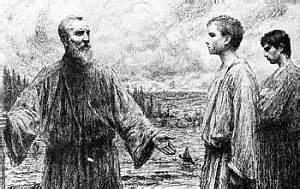
At the beginning of Luke 10 Jesus appoints 72 disciples to go ahead of Him. As He had already begun His journey up towards Jerusalem, these would go two by two into every town and place where Jesus was about to go. They were sent to preach much in the same way as John the Baptist, saying to those who were healed, “The kingdom of God has come near to you.” (v. 9) The 72 were sent out to carry Jesus’ Word to the people. He had given them this instruction, “Go your way; behold, I am sending you out as lambs in the midst of wolves. Carry no moneybag, no knapsack, no sandals, and greet no one on the road.” (vv. 3-4) Imagine being sent out today with no wallet, no phone, and no car. They were sent out with naught but what was on their backs into a world of drooling wolves, waiting in the dark corners to devour the seemingly helpless lambs. But, Jesus knows this – they are not unprotected. He sends them out carrying nothing but His Word.

Whatever house you enter, first say, ‘Peace be to this house.’” (v. 5) Turns out, these sheep were heavily armed. I bet the wolves weren’t expecting that. The 72 carried in their mouths the very Word of God, the Word concerning the peace between God and us through Jesus Christ’s life, death, and resurrection. This Word was power. Whenever the sick were healed, whenever demons were cast out, it was because the kingdom of God had drawn near. Where the kingdom of God is, there sin and darkness, chaos and destruction, sickness and death cannot be. And so, these disciples sent out seemingly naked were, in fact, not. They were clothed, protected, and provided for by the Word of God.

II.

So, these 72 are sent out ahead of Jesus to preach His Word in the villages and towns ahead of them. They were sent out without supplies, pretty much naked and defenseless. Some of them may have thought, what good could they possibly do like that. They may not have expected much. How surprised they must have been when people started being healed and demons started fleeing from the bodies they inhabited. Wow! What power they’ve been given! All of sudden their world is rocked. They aren’t some weak, defenseless sheep – they’re beef-eating, body-building sheep and those wolves should look out. These sheep have power! These sheep are rejoicing! Luke writes, “The seventy-two returned with joy, saying, ‘Lord, even the demons are subject to us in your name!’” (v. 17) Not only did Jesus’ Word grant lasting peace to the houses upon which it rested, but it also moved forward. It pushed out darkness as it moved forward. Jesus describes it, “I saw Satan fall like lightning from heaven.” (v. 18)

Imagine seeing this happen yourself: there you are praying over your sick relative. Maybe you’re at home, maybe you’re in the hospital and as you read Scripture and pray your relative is healed before your eyes. What joy you would have! You would certainly rejoice; I know I would. We should always be thankful and rejoice over God’s good will for us through His Son. This is how it starts out though, with thankfulness over healing. But give it time, and pretty soon we are tempted to look for something else miraculous. Maybe a friend was spared a close-call accident; that must have been a result of our prayers. I wonder what else we can do; what else do we have power over? If we keep on that path, we run into phrases like, “advancing the kingdom of God,” and “prayer warriors,” that are so frequently tossed around among Christian groups.

Like the 72, each of us is driven to look for signs of our election. We are tempted or are told to look around for miracles to confirm that we are the redeemed, that we have been given the Spirit from on high. Instead of looking to God’s Word and the Sacraments, especially the miracles of new birth and the union of Christ’s own body and blood with the bread and wine, we sometimes rejoice in other things. The 72 rejoiced in the power given to them and the visible signs accompanying it. What do we rejoice in? Do we look to outward signs for our assurance? Maybe not power, but possibly being filled with the Spirit? Maybe not being filled with the Spirit, but many of us take pride in being a Lutheran and not being like those other “Christians.”

III.

Behold, I have given you authority to tread on serpents and scorpions, and over all the power of the enemy, and nothing shall hurt you. Nevertheless, do not rejoice in this, that the spirits are subject to you, but rejoice that your names are written in the heavens.” (vv. 19-20) The 72 may have thought it was crazy that they were being sent out with nothing to back them up. Most likely there were many, many faithful among them who fully expected the power of the Word of God. That should show us how easy it is to rejoice for the wrong reasons. Jesus acknowledges to them the power His Word had, which He had given to them. His Word enables them to trample serpents and scorpions and to have power over all the might of the enemy. Because of His Word, nothing would ever hurt them. The 72 saw all that and rejoiced the visible signs of that miraculous power.

We too have had Jesus’ Word of peace put into our mouths. The name of the Triune God was spoken over us at baptism and in the Supper we are continually strengthened in the faith. Called by the Holy Spirit we are equipped with the same Word of peace and are lead to share it with those around us. Sometimes we may see miracles; or even if we do not see them, they may still happen. But, we are not to rejoice in what we see. After confirming the power of His Word Jesus says, “Nevertheless, do not rejoice in this…but rejoice that your names are written in heaven.” (v. 20)

Even though the Old Adam daily tempts us to rejoice in signs, we have been given something greater. Through Jesus’ meritorious life, death, and resurrection, and through His continual pleading our case before the throne in heaven, we have peace with God and our names are written in His Book of Life. We rejoice that no longer does God see sinners when He looks at us, but He sees His own Son, Jesus Christ. We have been adopted as sons and heirs of the promise. We have been given the right to eat from the tree of life. That is why we are to rejoice. Now notice, not all of those things are visible in this life. So then, it seems, that we should not look to visible signs, even as they may happen, for our rejoicing. Rather than rejoicing in signs, we rejoice in the fact that, through Christ and His Words, all of our names are written in heaven.

Sermon for the 5th Sunday after Pentecost – “The Heirs Apparent,” Galatians 4:1-7

When I was a child, I thought like a child. I acted like a child and I reasoned like a child. And I reasoned that I was a slave. I did; I really did. I reckoned that I was a slave. It wasn’t always negative, but I did wake up every morning and do whatever my parents told me to do. Get up; Go to school; Wear pants while eating; Mow the lawn. It went on and on. Sure, there was often promise of payment – but that promise was not always realized. It seemed to me, for all intents and purposes, that I was a slave. I couldn’t see the whole picture. I couldn’t see that even though I was a son, for a time I was kept under the guardian of rules and chores in the role of slave until such time when I would be released and be given the status of a son. In the text today it says that, in the fullness of time, God sent His Son to redeem those who were slaves under the Law, in order that they might receive adoption as sons. We are those who have been adopted as sons. THROUGH THE REDEMPTION THAT IS IN CHRIST, OUR STATUS HAS BEEN CHANGED FROM THAT OF A SLAVE TO THAT OF A SON.

(I.            As long as the heir is a child, he is no different from a slave.)

(II.           In the fullness of time, God sent His Son to change slaves into sons.)

I.

          Paul has been working now through chapters 3 and 4 to try and describe what is going on between God and us because of Christ Jesus. We read his account of the Jerusalem Council in chapter 2 and his encounter with Peter in Antioch before Paul drops this bombshell, “We know that a person in not justified by works of the law but through faith in Jesus Christ.” (Gal. 2:16) Paul then uses the distinction between the Law and the Promise to show who exactly the offspring of Abraham are – those who were baptized into Christ and have put on Christ. Those who are in Christ are now heirs according to His promise.

But if we are heirs of the Promise as Paul says, what is that whole Law of God thing about? Paul writes, “I mean that the heir, as long as he is a child, is no different from a slave, though he is the owner of everything, but he is under guardians and managers until the date set by his father.” (vv. 1-2) The imagery here is from Greco-Roman law. Both stated that a son was considered a minor until he was around 18 years old, much like today. Legally, the son was a son, but was not able to enjoy the benefits of being a son. He had no right to his inheritance or the property of his father and he was kept under the watch of a guardian who would keep him in line until such a time was set by his father for him to become an adult.

In the same way, Paul writes, “we also, when we were children, were enslaved to the elementary principles of the world.” (v. 3) When I was a child I thought like a child, acted like a child, and reasoned like a child. I reckoned that I was slave. I was right. But I wasn’t just right about me – we were all slaves. As children, in our old sinful nature, we were slaves. Apart from Christ we were slaves both to the Law and to our own heathen activities. We were slaves to the Law in that that which was put into place to curb sin was turned by the Old Adam into an idol. Instead of having the Law as blinders, like uneducated children we put the Law directly in front of our eyeballs so that all we would see is that; but we didn’t even know it. Do to others as you would have done to you was the golden rule we lived by as we ourselves locked the shackles of Law upon our arms and legs.

Or, instead of being slaves to the Law we were slaves to freedom. We released ourselves from the stocks of legalism only to be encased in the glass prison of freedom. We lived as we wanted and taught others to do the same. Out of fear of telling people that something is not permitted, we became slaves to our own tolerance. Thus on either side, the Law or freedom, we were slaves. As children and apart from Christ, that is what we were. Truly, as Paul says, before faith came we were held captive.

II.

            “But when the fullness of time had come, God sent forth His Son, born of a woman, born under the Law, to redeem those who were under the Law, so that we might receive adoption as sons.” (vv. 4-5) Under Greco-Roman law a male child was pretty much a slave until a time set forth by the father. He was a son, but he had no access to the benefits contained therein. In Greece the change from slave to son took place during the festival of Apatouria while a Roman child became an adult during the Liberalia. It was there that a father formally claimed his son as an heir and the child’s dress was changed from a child’s toga to that of an adult. Paul writes to us about the time when we were changed from slaves and received the full status of sonship. When the fullness of time had come, when time had reached and fulfilled its purpose, God sent forth His Son from heaven to be born on earth. The eternal Son of God was sent to break forth into time and be born of a woman and under the law. The master was made a slave so that the slaves could become masters.

In order to take us from our guardian of the Law and from our turning it into an idol, Jesus was born under the Law just like us. In order to save us from the prison of freedom Jesus was tempted in every single way possible, yet without sin. All this He did in order to redeem us, who were under the law. In His death on the cross He paid for our sins and removed the reason for which the Law exists. In His resurrection Jesus has removed the guardian and has made us sons, adopted through faith in Him.

And because you are sons,” Paul writes, “God has sent the Spirit of His Son into our hearts, crying ‘Abba! Father!’” (v. 6) And now, because we are sons who have been redeemed by His blood and adopted by His grace, God has sent to us the Spirit of His Son, the Holy Spirit that proceeds from both the Father and from the Son. The Spirit cries out within us, “Abba! Father!” It cries out, “Daddy!” Because of the redemption we have in Christ Jesus. And through His Spirit, as sons we have a direct line to God our Father. At any moment we can pray and know without a doubt that we are heard. We are no longer slaves who follow orders and who may not ever hear directly from the master. We have a direct line to God in our prayers and hymns while God speaks to us through His Word and Sacraments. In His Holy Scripture we hear of the salvation that has appeared before the face of all people – our Savior who became flesh under the Law in order to redeem us and make us sons instead of slaves. No longer do we eat the sloppy, tasteless meal of a slave but we feast extravagantly on the body and blood of Jesus Christ, the life-giving meal that is more satisfying than we can ever know – one of the many benefits we now have as sons.

So you are no longer a slave, but a son, and if a son, then an heir through God.” (v. 7) When I was a child I thought I was a slave. Turns out I was right. In our old nature, apart from faith in Jesus Christ, each and every one of us was a slave. Though we were predestined to life through Jesus, we turned the Law into our master or let our misguided understanding of freedom imprison us. But now, through Christ, through His being born under the Law to suffer and die in our place, we have been adopted as sons of God. We have been given the Holy Spirit, which cries out within us and grants us the privilege and right to speak to our Father in heaven to receive our Lord’s Body and Blood here on earth. So then, we are no longer slaves. We are sons.