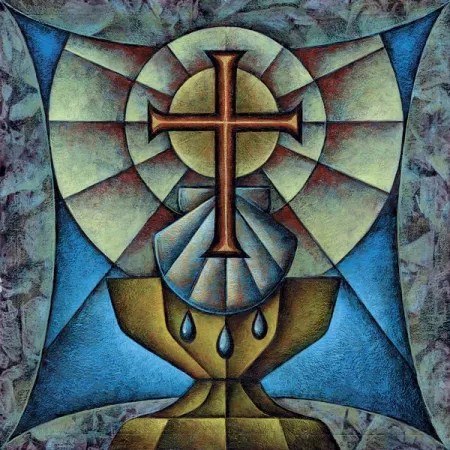
As this past Sunday was our celebration of the Feast of All Saints, I thought it would be more than appropriate for my first issue to reflect on baptism. This is not only because St. John’s witnessed a baptism during our All Saints’ service, but this holy day also brings to mind our own baptisms, as this is how Christ makes us His own, for we have been washed in the blood of the Lamb and are made children of our Heavenly Father.
First, what is baptism? Luther explains in his Small Catechism, “Baptism is not just plain water, but it is the word of God included in God’s command and combined with God’s word.” Baptism is not just a ceremony we perform for small children and those who have not yet been baptized. It is much more; it is a sacrament. It is the word of God that, combined with the element of water, makes it a sacrament. We follow our Lord’s command as he tells his disciples to “Go and make disciples of all nations, baptizing them in the name of the Father and of the Son and of the Holy Spirit.”
We are truly sealed by God through this sacrament. Just as kings and rulers would stamp a seal on a decree, marking it as a legitimate statement that has authority and influence, the Lord does the same. For we are all descendants of Adam and born under the condemnation of sin. Before faith, we have no access to God, we cannot merit forgiveness, and we cannot produce anything good in ourselves. Still, through the Holy Spirit, God gives us faith. We are made children of God through adoption, not by any work or worthiness of our own, but entirely upon the death of Christ, in whose words we are baptized.
Second, what benefits does baptism give? Or, in other words, what do we receive from God as adopted children? Luther again states, “It works forgiveness of sins, rescues from death and the devil, and gives eternal salvation to all those who believe as the words and promises of God declare.” As we know, it is the word and name of God in baptism; therefore, it must have an effect on us. It was the word of God that created the heavens and the Earth, and it is in the name of Jesus that the apostles cast out demons and performed miracles. The word of God accomplishes its purpose as our Lord says in Mark 16, “whoever believes and is baptized will be saved.”
Third, how can water do such great things? For a washing without the word is no baptism, as it remains plain water. Ordinary water has many purposes. Water can destroy things, such as in a flood. Water can give life to plants and animals. Water can also wash away dirt and stains. Water can rarely perform any two of these things simultaneously. Meanwhile, this is what we see in baptism, as it is a combination of water and the word. For it drowned and condemns the old Adam inherited in us, gives us new life and Christ, and forgives us our sins. As Paul says in Titus 3, “He saved us through the washing of rebirth and renewal by the Holy Spirit, whom he poured on us graciously through Jesus Christ our Savior, so that we, having been justified by his grace, might become heirs having the hope of eternal life.”
Finally, what does baptism with water indicate? It indicates that by faith, the old Adam in us, our sins and evil desires, should die daily so that we may rise to righteousness and purity before God. In the same way that our status before God has changed by faith and baptism, this means that we change as well. We now live under the kingdom of God, and we demonstrate this through our words, thoughts, and actions. And while we still struggle against sin, we know that it is the new man in us that will win the final victory by the death of Christ for our redemption. As St. Paul also writes in Romans 6, “We were therefore buried with him through baptism into death in order that, just as Christ was raised from the dead through the glory of the Father, we may live a new life.”
As members of the Church here on earth, we wait to behold Christ face-to-face and join in the company of all the Saints. So when we still struggle with the burdens of this world, we have our baptisms that have lifted the burden of sin by the death of Christ and have united us to our Savior. As united to Him, Christ always remembers us, desires to forgive us, and will bring us into His heavenly kingdom.
 St. John's and Grace Evangelical Lutheran Parish