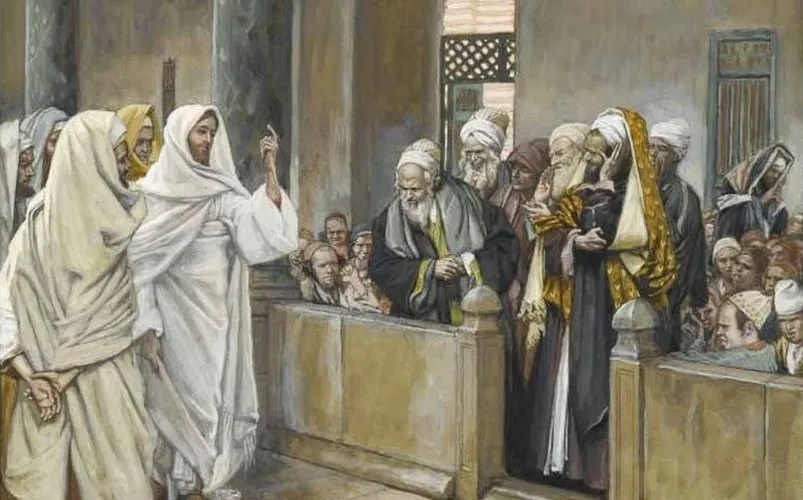
Today, in our gospel reading, we find a surprisingly unique interchange between Christ and the Sadducees and the teachers of the law. They attempt to confuse and entrap Jesus, but to their amazement, Christ not only answered a question that they cannot answer. They were also put to shame. And in return, he inquires of them about who they believe the Christ is. And to this, they have no answer because, in the end, it would result in Jesus as the promised Messiah, the fulfillment of the law, and the payment for sin.
The question for Jesus was, “Which is the great commandment in the Law?” It is a last-ditch effort to try to stump Jesus. Prior to this passage, Jesus had answered all their questions using the scriptures pointing to him as the Christ. It is one lawyer who fires this question across the galley in order to provoke him. The Gospel of Matthew says that this was in order to “test” the Lord. This young lawyer and scholar of the Scriptures obviously does not know the word of God at all. As he is not the first one to test the Lord.
We do not need to look further than in the book of Exodus. After the Lord has delivered the people of Israel out of bondage from the house of slavery in the land of Egypt by crossing the Red Sea on dry ground, and even after receiving the bread from heaven. They became thirsty and began quarreling with Moses and testing the Lord. It is their natural inclination to sin that takes over the hearts of the people of God as they become indignant and impatient with the servant of God who brought them out of the house of slavery, and in the end, they do the same to God himself. As the Lord brought the people into the wilderness to test them. And they would be purified and prepared to enter into the land of promise; it is the people who test the Lord.
In their groaning, they prove themselves to be sinners. To be taken over by their passions of body and soul, to be satisfied the moment when desire comes. In this way, the young lawyer is just like the people of Israel, wanting to trap God to get what he wants instantaneously. He desires Christ to change the Law so that he may justify himself. For even asking such a question, he would like to limit the law so that it would never accuse him of any sin whatsoever. And as a result, Jesus humbles this self-justifying man by exhorting him to love God with all that he is, and to love his neighbor as himself.
It is easy for us to look down upon the young lawyer and the people of Israel in the wilderness as they tested God to change his commands, but are we much different than them? How often do we allow our tendency to sin to obscure our vision of the law of God? This may be when we say to ourselves or to God, “Yes, I feel bad about what I did, but I technically didn’t break a commandment.” We might say I told that small lie to save my job, and God doesn’t want me to lose it. Or it technically isn’t stealing because they owe me that in the first place. Or it’s not really adultery, because we truly love each other.
These are all cases where our sinful nature takes us captive once again. We diminished the law’s accusations against us. It is as if, instead of using a magnifying glass to examine the Ten Commandments to find all our shortcomings and wrongdoings, we turned the glass over to magnify ourselves and to make the law of God unreadable. We do this to call ourselves great and noble Christians by making the law so precise that no person could be found guilty.
What makes this thinking dangerous is that when we make our sins so small, we also make small the need for a Savior. We may think we are doing ourselves a favor, but instead, we are doing ourselves much harm. As it is of no benefit to us, for this is how we sin against God.
But to this, I say, let the law accuse you. Let every commandment of God find you guilty. And let every secret sin be brought to light before God. Let the commandments of the Lord leave you dead in your trespasses and sins, so only Christ can raise you up. For he is your pure and holy Savior waiting to forgive you for all that you have done. Waiting to receive you. Waiting to comfort you with his love and grace. This is why Jesus looked upon this young lawyer with compassion. As the Lord offers him a question concerning the Christ. He is asked, “Whose Son is He?”
Jesus is, of course, the Christ. And he is both the Son of David and the Son of God from all eternity. Christ is the one whom God says, “Sit at my right hand, until I make your enemies your footstool.” What a marvelous saying of our Lord’s victory! For our Lord is not referring to us as God’s children still long under the bondage of sin. The enemy that must bow down to Christ, must be forced into submission under his feet, and finally must be destroyed by God himself, is not us, but is sin itself.
And where are these words and promises of God fulfilled? It is at the Cross of Calvary, where Jesus Christ, the very Son of God, in flesh and blood, who is also the Son and Lord of David, takes his proper place upon the throne of his forefather, not in a luxurious palace, but in the place of the skull where he dies. He does not die, the noble death of a king, but he dies in the company of hardened criminals. For he bears our chastisement and the condemnation of the world. By the death of Christ, we do not fear the law; in it, we have our perfect and obedient Savior who has washed away all our sins and has thrown them into the depths of the sea.
So when we come to the judgment seat of God, we do not need to fear that he will put us under his feet. So when the law of God is placed before our eyes, we can say, “Yes, I have committed all of these and many more, but I have the blood of Jesus Christ, who loves me and who has given his life for me.” Do not fear any letter of the law, for it is given by your savior who has loved you and has redeemed you. And he is the giver of all good gifts.
 St. John's and Grace Evangelical Lutheran Parish