Text: 1 Corinthians 9.24-10.5
In the Gospel reading this week, we heard about God’s gracious attitude toward us in Christ. Throughout the generations, through His many faithful witnesses, the Lord has sent the Good News of the forgiveness of sins out into the world. According to His will, He causes people to hear His Word at various times and in different ways and works in them the gift of faith: now, some people over here; then, some over there. Through hearing the Word, faith is created and the forgiveness of sins is bestowed. Through the same Word, all who are called to faith in Christ are also led by the Holy Spirit to share His Good News with the world. Our Lord describes this to us as a master calling laborers at different times to work in His vineyard. By His grace, they all received the same wage – whether they had worked long or short. So, too, does the Lord reward us not according to our many years in the congregation but according to His grace.
At the end of the day, though, those who had worked the entirety found themselves at odds with the master of the house. They had agreed with Him for a denarius (which was a day’s wage) but, when the time came to receive their payment, they figured to receive more. They wanted more because they had changed for themselves the expected outcome of their labor. Our Lord doesn’t say whether they actually received their denarius. It’s possible, knowing what we do about people, that they were so upset they left it behind. Jesus said in another parable, “To everyone who has more will be given…But from the one who has not, even what he has will be taken away.” (Matthew 25.29 ESV) Those laborers, to bring in St. Paul’s epistle, were found to have been boxing with the air and running aimlessly. They did not receive the end of their labor. Today, St. Paul encourages us to run our course of faith with purpose, that is, that we keep what God has promised as our sole focus.
I.
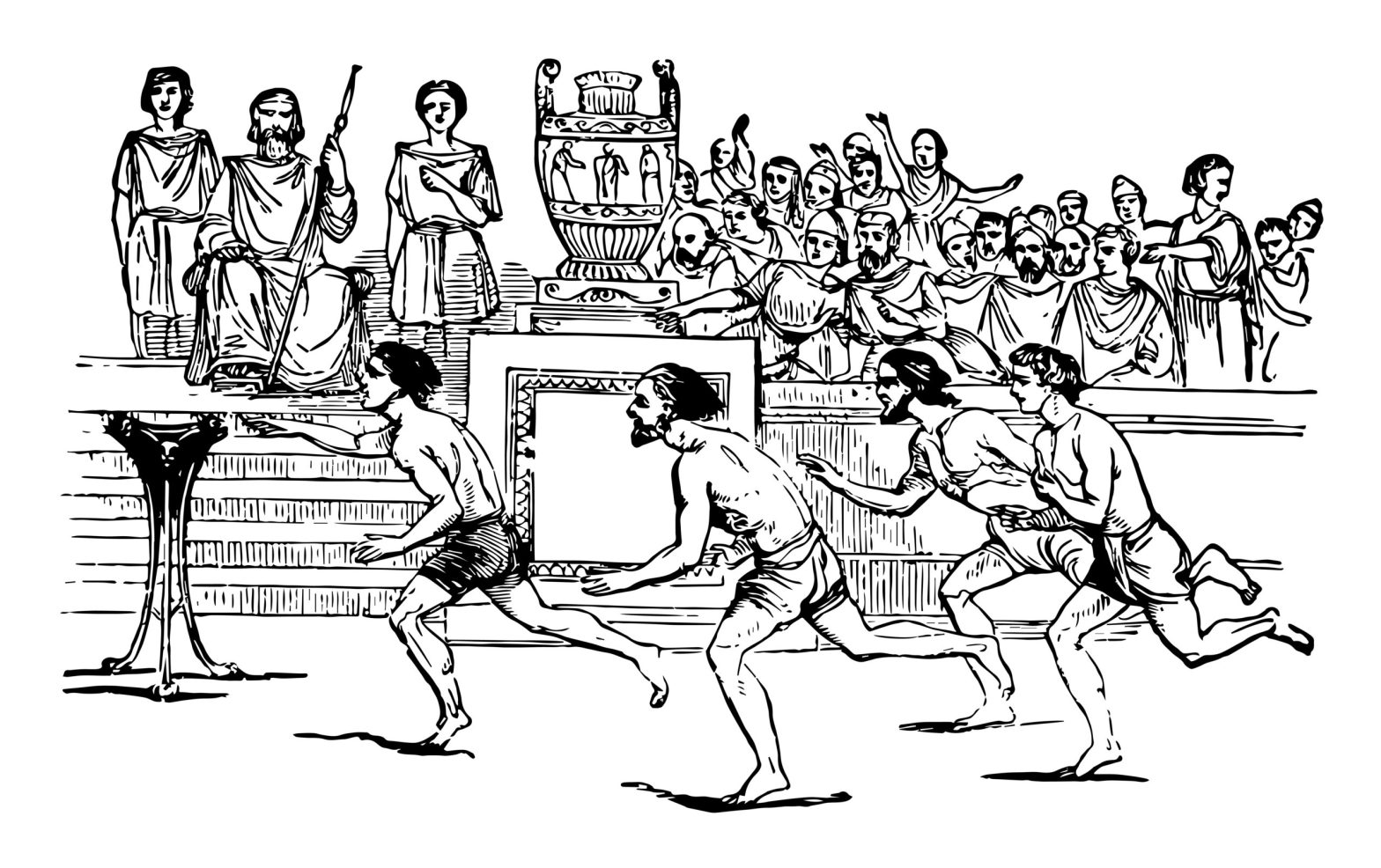
By the inspiration of the Holy Spirit, St. Paul writes to us, “Do you not know that in a race all the runners run, but only one receives the prize? So run that you may obtain it. Every athlete exercises self-control in all things. They do it to receive a perishable wreath, but we an imperishable.” (1 Corinthians 9.24-25) Apparently, not far from Corinth, there was an athletic competition that was second only to the Olympics. It was called the Isthmian Games, which featured events such as running, wrestling, boxing, javelin throwing, jumping, and the discus. It seems that one of these games was held during St. Paul’s stay in Corinth. He and the congregation would’ve had the opportunity to witness these events and ply their trades. Paul, by vocation, made tents – useful for out-of-town visitors to the games. So, Paul used here something in the mind of the Corinthians to teach them.
Of course, he’s not preaching to the Corinthians about running or boxing in the games but running the race, fighting the good fight, of faith. In that regard, the Corinthians were in danger of missing the finish line or landing punches only on thin air. The Corinthians had lost sight of what the Lord had called them to. When they received the forgiveness of sins through faith in the Gospel preached to them, they had been called to lives of faith and service. They had been freed from the condemnation of the Law and the chains of sin and death. Sadly, they were misusing their freedom. In close connection to our text was the issue of eating food sacrificed to idols. Truly, there is no reality behind an idol. There is no real figure or power behind their representation because there are no other Gods other than the Lord. Knowing this, it was permissible for the Corinthians to eat food that had been sacrificed – but not if it caused spiritual harm to their neighbor. Some newer members, who had not yet fully realized that there were no other gods, could see older members eating that food and reach the wrong conclusion. But, apparently, that didn’t stop them.
There were other ways that the Corinthians were running the wrong way. One among them was in a sexual relationship with his stepmother – with the knowledge of the rest of the congregation – who did nothing. The members of the congregation brought lawsuits against each other. Some continued to engage prostitutes in the pagan temples. In short, they were very much in danger of running their course in vain. It was very possible that they would end up like so many of the Israelites, who were laid low by God in the wilderness. Moses tells us that 600,000 fighting-age men went through the Red Sea out of Egypt but only 2 – Joshua and Caleb – made it to the Promised Land. Rather than receiving the call of Christ as an invitation to love and service, reflecting the free forgiveness of sins, the Corinthians claimed Christ’s power as their own and were in danger of missing the finish line.
II.
This is a danger we, too, face. The reality of the Corinthians is also ours. Just as Jesus Christ came in the flesh for them, so He entered His creation for us, too. He placed Himself beneath the Law for us, as well, and kept its righteous demands in our stead. He suffered for our sake the punishments due our sins and bore the wrath we merited when He was forsaken by the Father for us on the cross. When He rose from the dead, it was so that death’s hold over us would be ended and that the devil no longer have any power to threaten us. In a word, we are free. We are free from sin, free from death, free from the devil and hell. We are free to serve, wherever the Lord has placed us. We have received His gracious invitation and look forward to its reward. Or, at least, we should.
Rather, the danger we face with the Corinthians is that we misuse our freedom in Christ. Instead of using our freedom to serve Christ and our neighbor, we serve ourselves. That’s pretty much the definition of sin, that we serve ourselves instead of God and others. When the Corinthians knew there was a man caught in sexual immorality among them, they didn’t do anything. St. Paul called their reaction to the matter, “arrogant,” for they decided that, since Christ’s grace is more powerful than sin, they could just let him continue. Don’t we do this with our sins? None of us has struggled against temptation as strongly as we should. Sure, we resist for a time but, almost inevitably, we give in. As this pattern becomes a habit, we begin to excuse ourselves. We figure, since Christ is going to forgive us, what difference does it make if we add another sin to our account?
We do this with the Third Commandment when we don’t read our Bibles. Maybe we think that, since we’re not all pastors, we don’t need to study it or grow in our understanding. We fail to see that as rejecting the Word of God. When we are angered by our neighbor, we don’t immediately repent of it but entertain it, sometimes for a great long time. When our neighbor is angry at us, we hesitate to be reconciled because we don’t want to admit our sin. We all can think of things that our neighbor has, that we feel we would more justly enjoy. Lastly, we misuse our freedom in Christ as a coverup for evil against the Sixth Commandment when we do not honor our marriages as we should: by loving, sacrificing joyfully, and forgiving one another; by extolling marriage and commending it to future generations. Instead, our marriage, at times, is the last thing on our minds. All these things, and more, we have done as Christians. We’re running the race, sure, but we’re veering off the course. St. Paul envisioned a race in the stadium around a track. Perhaps we could think of running cross country but missing a turn and wondering where the course is going.
III.
St. Paul said, “So I do not run aimlessly; I do not box as one beating the air. But I discipline my body and keep it under control, lest after preaching to others I myself should be disqualified.” (26-27) For the Corinthians, there were some definite literal applications here. The man who shared a bed with his stepmother had to stop (which, he did). Those who engaged temple prostitutes in their former lives must do so no longer. If someone is burdened by lust, he or she should seek to be married. Those who were hungry for meat could get it somewhere other than the in-house restaurant at the local pagan temple. Running the race to which God had called them in Christ required bearing their crosses and keeping their bodies (and minds) in check. Same for us.
Many of us, most of us, were called to faith in Christ as children, in our Baptisms. We have been drafted into the Lord’s vineyard for service in His name or – to stay with St. Paul – entered into a race. This race has a great reward for its price, the imperishable wreath of eternal life. We want this prize, therefore we must run this race with purpose. We must keep our bodies in check and desire firmly what our God has promised. On our own, this is impossible. We all learned in the catechism that there is no merit or worthiness in us. Thankfully, God the Holy Spirit is already working in our hearts. For one, we are here right now. He has placed a desire to hear God’s Word in our hearts. May He grant us, also, to listen to it and earnestly desire what He says. We know that He will. May He grant us contentment with the denarius promised – the forgiveness of sins and eternal life – and a desire to live and serve accordingly. Amen.
 St. John's and Grace Evangelical Lutheran Parish